Rubik’s Cube Beginner Method Algorithms: The 7 You Need (Cheat Sheet)
All seven beginner method algorithms on one page: the move sequence for each step, when to use it, and the four last layer algorithms.
The beginner method needs seven algorithms, and one of them is just four moves. In order: white cross (no algorithm, done by eye), white corners R U R' U', middle layer U R U' R' U' F' U F (right) and U' L' U L U F U' F' (left), yellow cross F R U R' U' F', yellow edges R U R' U R U2 R', yellow corner positions U R U' L' U R' U' L, and yellow corner twists R' D' R D. This page is the cheat sheet: each algorithm and the exact situation that calls for it. The full walkthrough is in how to solve a Rubik’s cube.
The 7 beginner method algorithms in order
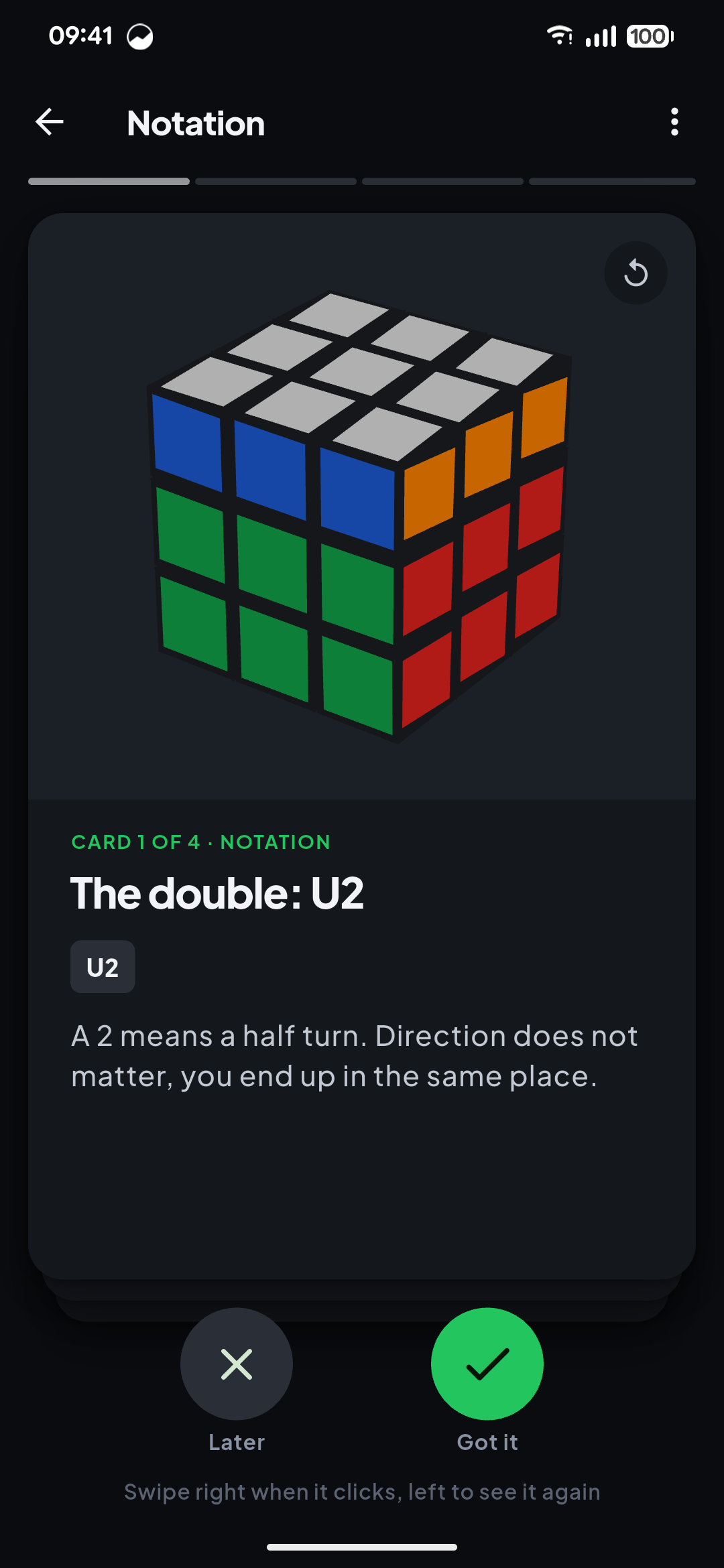
Hold the cube with white on the bottom and yellow on top for every step, and do not rotate it while you are inside an algorithm. Letters mean the face to turn, a prime (') means anticlockwise and 2 means a half turn. If any of that is new, read Rubik’s cube notation explained first.
1. White cross: no algorithm
When: the cube is scrambled. Bring the four white edges up round the yellow centre, match each side colour to its centre, then turn that face twice to drop the edge. Solved by eye.
2. White corners: R U R' U'
When: a white corner sits in the top layer directly above the empty slot it belongs in, on your front-right. Repeat the four moves until the corner drops in white-side-down (one, three or five repeats). A corner stuck in the wrong bottom slot gets the same algorithm once to pop it out.
3. Middle layer, right: U R U' R' U' F' U F
When: a top-layer edge with no yellow on it has its front colour matching the front centre, and its top colour matches the centre on the right. Do the algorithm and the edge slots in between the front and right centres.
3b. Middle layer, left: U' L' U L U F U' F'
When: the same setup, but the edge’s top colour matches the centre on the left. If a middle edge is in place but flipped, do either algorithm once to kick it to the top, then insert it properly.
4. Yellow cross: F R U R' U' F'
When: the first two layers are done and the yellow edges on top form a dot, an L or a line. Hold an L pointing back-left, a line running left to right, and run it once. A dot needs up to three runs. Ignore the corners.
5. Yellow edges: R U R' U R U2 R'
When: the yellow cross is done but the edges’ side colours do not match their centres. Turn the top until two adjacent edges match, hold them at the back and right, and run it once. If only opposite edges match, run it once from any side first.
6. Yellow corner positions: U R U' L' U R' U' L
When: the yellow edges are solved but the corners are in the wrong spots. Hold a corner that is already in its place at the front-right and run it; the other three cycle. No corner correct? Run it once from anywhere, and one will be.
7. Yellow corner twists: R' D' R D
When: every corner is in its place and some are twisted. Hold a wrong corner at the front-right and repeat the four moves until its yellow faces up, then turn only the top layer (U) to bring the next wrong corner to the front-right and repeat. The cube looks destroyed halfway; it comes back on the last corner.
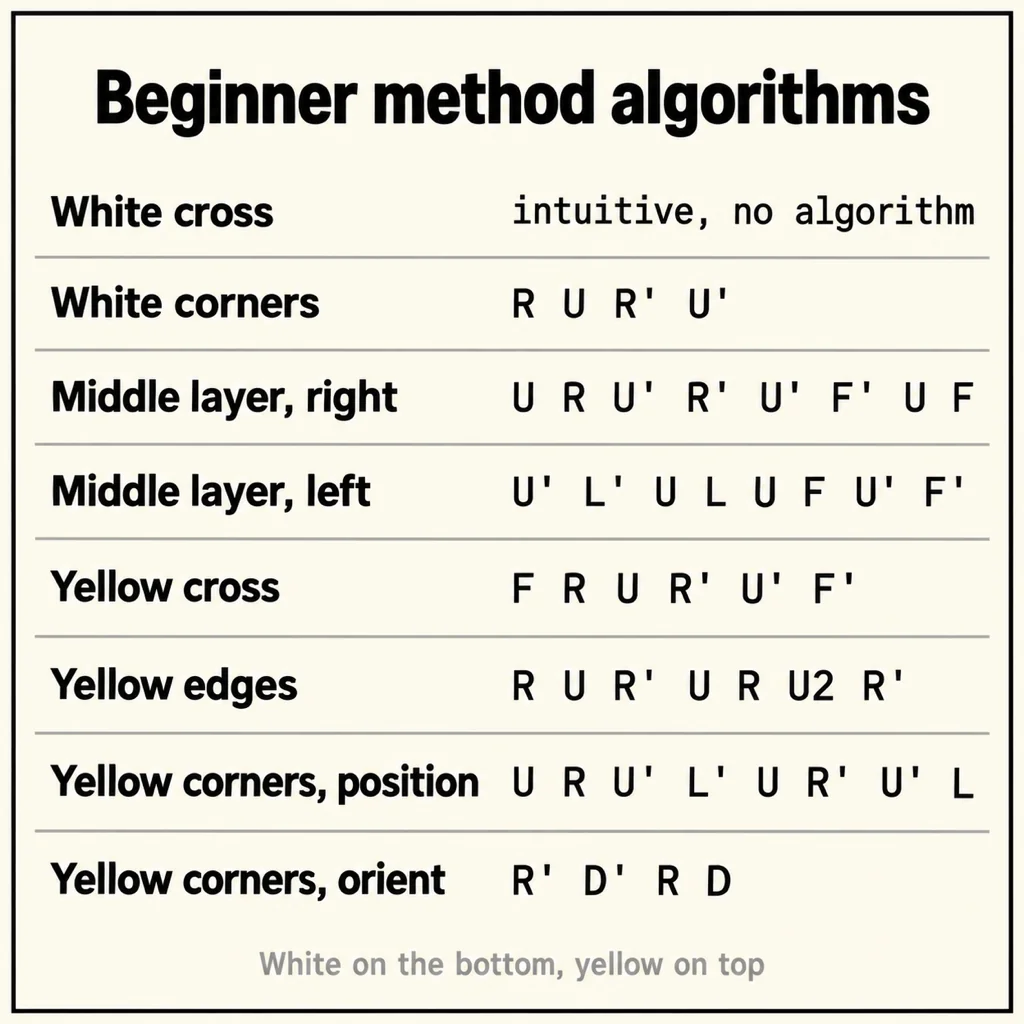
Beginner method algorithms list (cheat sheet)
- White cross: intuitive, no algorithm
- White corners: R U R' U' (repeat until the corner drops in)
- Middle layer, right: U R U' R' U' F' U F
- Middle layer, left: U' L' U L U F U' F'
- Yellow cross: F R U R' U' F'
- Yellow edges: R U R' U R U2 R'
- Yellow corners, position: U R U' L' U R' U' L
- Yellow corners, orient: R' D' R D (repeat, then U to the next corner)
Eight lines for seven steps, because the middle layer has a left and a right version. Learn the right one first; the left is its mirror.
Beginner method last layer algorithms
The last layer is where most people stall. Its four algorithms, in order: F R U R' U' F' makes the yellow cross, R U R' U R U2 R' matches the edges to the sides, U R U' L' U R' U' L places the corners, and R' D' R D twists them. Each leaves the two solved layers intact as long as you start from the right position. The two usual mistakes: holding the L the wrong way round in step 4, and rotating the whole cube instead of just the top layer between corners in step 7. If this is where you are stuck, what to do after the white face picks up from exactly that point.
How to memorise the beginner method algorithms
- Learn them in the order you use them. You will do R U R' U' twenty times before you need the yellow cross, so the first half is automatic before the last layer arrives.
- Learn the motion, not the letters. R U R' U' is one hand movement; once it is in your fingers you stop reading it, and most of the other algorithms are built from it or its mirror.
- Say the letters out loud the first few times. Hearing them sticks better than reading them.
- Notice the structure. The yellow cross is F, then R U R' U', then F'. R' D' R D is the corner trigger moved to the bottom. Patterns stick; random strings do not.
- Solve twice a day for a week. Most people drop the sheet by the tenth solve; the two corner algorithms are the last to stick.
Beginner method vs CFOP algorithms
The beginner method uses seven algorithms and roughly 100 to 150 moves per solve. CFOP, the speedcubers’ method, pairs up the first two layers and finishes the last layer in two steps with 57 OLL and 21 PLL algorithms, about 60 moves in all. The bridge is 2-look OLL and PLL, about ten algorithms that replace beginner steps 4 to 7, and two of them are already in your hands: Sune (R U R' U R U2 R') and F R U R' U' F' are both OLL cases. Learn the beginner set until you can solve without looking, then decide whether speed matters.
Where a solver app fits
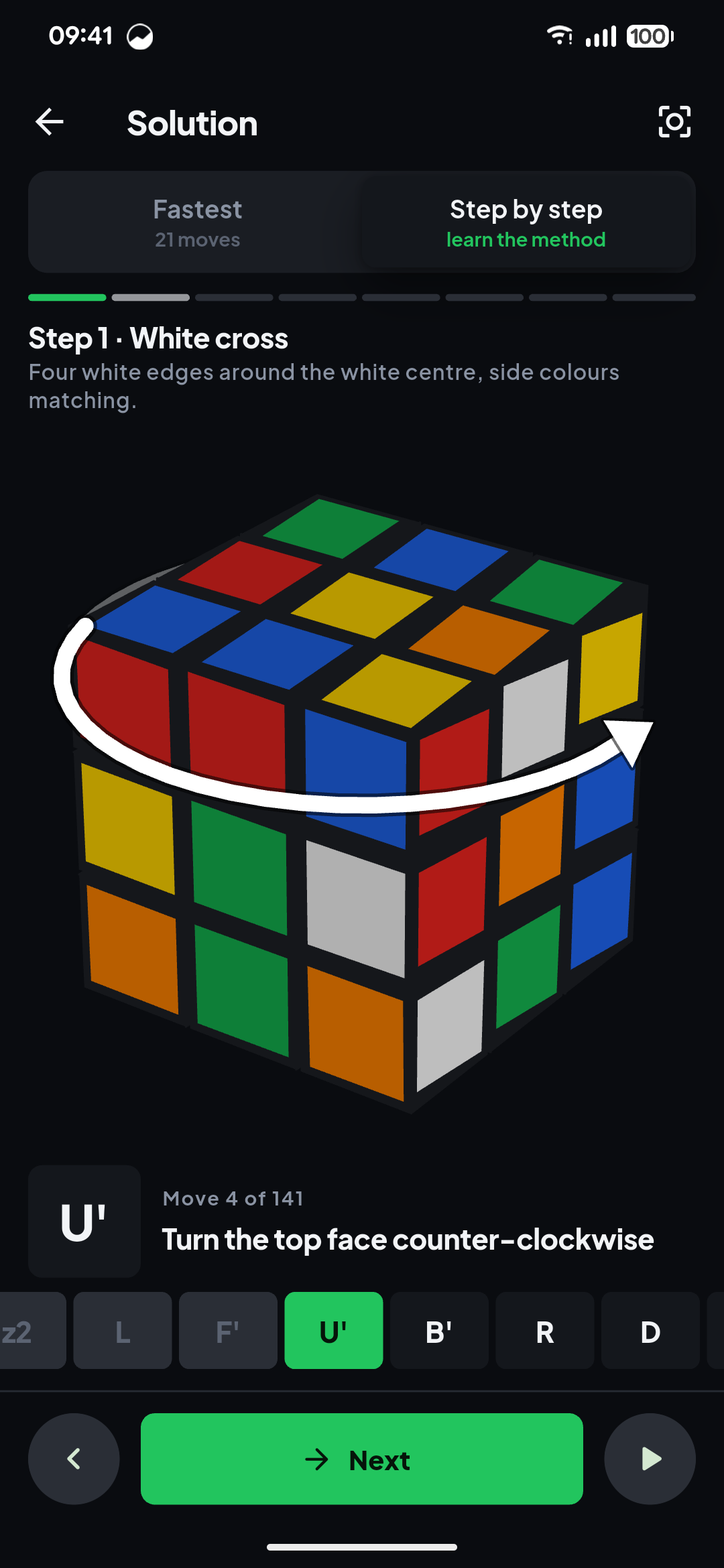
A cheat sheet gives you the moves; it cannot tell you which case you are looking at, and that is where beginners get lost. Cube Solver: Scan & Solve 3D scans your cube with the camera (or you tap the colours in) and its Step by step mode solves that exact cube the beginner way, stage by stage, every move animated on a 3D cube with an arrow on the layer to turn. It also has swipe-card lessons on the notation and the method. Free with ads on Android; one purchase removes them. Use it to check which algorithm a position needs, then try to call it before the app does.
Common questions
How many algorithms does the beginner method use?
Seven, or eight if you count the left and right middle layer versions separately. The white cross has none.
What is the easiest algorithm to start with?
R U R' U'. It is four moves, it solves the white corners, and it appears inside the yellow cross algorithm too.
Which beginner algorithm is the Sune?
R U R' U R U2 R', used in step 5 to match the yellow edges to their centres. It is also a standard OLL case in CFOP.
Why does R' D' R D mess up my cube?
It is supposed to look broken between corners. Turn only the top layer to bring the next corner to the front-right, finish all of them, and the lower layers restore themselves.
The short version
Seven algorithms: white cross by eye, R U R' U' for the white corners, U R U' R' U' F' U F and its mirror U' L' U L U F U' F' for the middle layer, F R U R' U' F' for the yellow cross, R U R' U R U2 R' for the yellow edges, U R U' L' U R' U' L to place the last corners and R' D' R D to twist them. Learn them in that order, in your fingers rather than on paper. For the full method with hand positions, read how to solve a Rubik’s cube; for the wider set beyond the beginner method, see Rubik’s cube algorithms.
From the studio
Previous Article
Samsung to Mac File Transfer: Every Way That Still Works in 2026
Next Article
Transcribe Voice Memos to Text: iPhone, Android and Mac