How to Solve Rubik’s Cube Faster:From 2 Minutes to Under 30 Seconds
How to solve a Rubik’s cube faster after the beginner method: finger tricks, a speed cube, cross on the bottom, 4-look last layer, F2L and look-ahead.
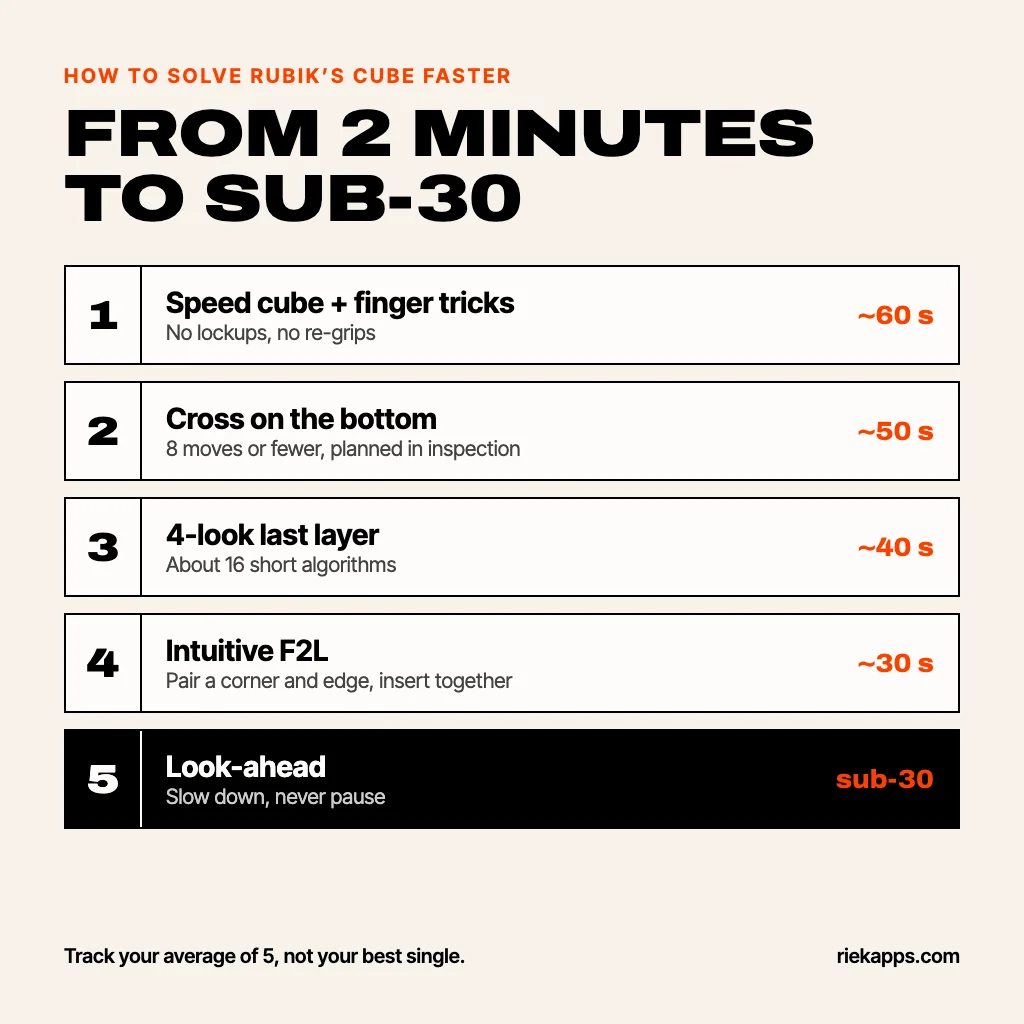
To solve a Rubik’s cube faster, stop turning faster and start pausing less: learn finger tricks, solve the cross on the bottom, switch the last layer to 4-look (about 16 short algorithms), then replace the first two layers with F2L and practise looking ahead. That path takes most people from 1–2 minutes with the beginner method to under 30 seconds. Below is each step in the order that saves the most time, with what to practise and how long it usually takes.
First, know where your time goes
Before changing anything, time ten solves and watch yourself on the last two. Beginners almost always lose time in the same places: staring at the cube looking for the next piece, rotating the whole cube to see a face, and slow, wristy turns on long algorithms like the corner swap. Speed comes from removing those pauses, not from moving your hands like a blur.
If you can’t solve it yet, start with how to solve a Rubik’s cube: everything below builds on the beginner method.
Track an average of 5 rather than your best single. Speedcubers drop the best and worst of five solves and average the middle three, so one lucky scramble doesn’t fool you.
Step 1: Get a speed cube
A stiff store-bought cube catches and locks up (“lockups”), and every lockup is a second or two. A modern magnetic 3x3 speed cube costs about the same as a takeaway lunch, turns with a flick, and corrects small misalignments. It is the cheapest few seconds you will ever save. Don’t over-lube it; a factory-lubed cube is fine for months.
Step 2: Learn finger tricks
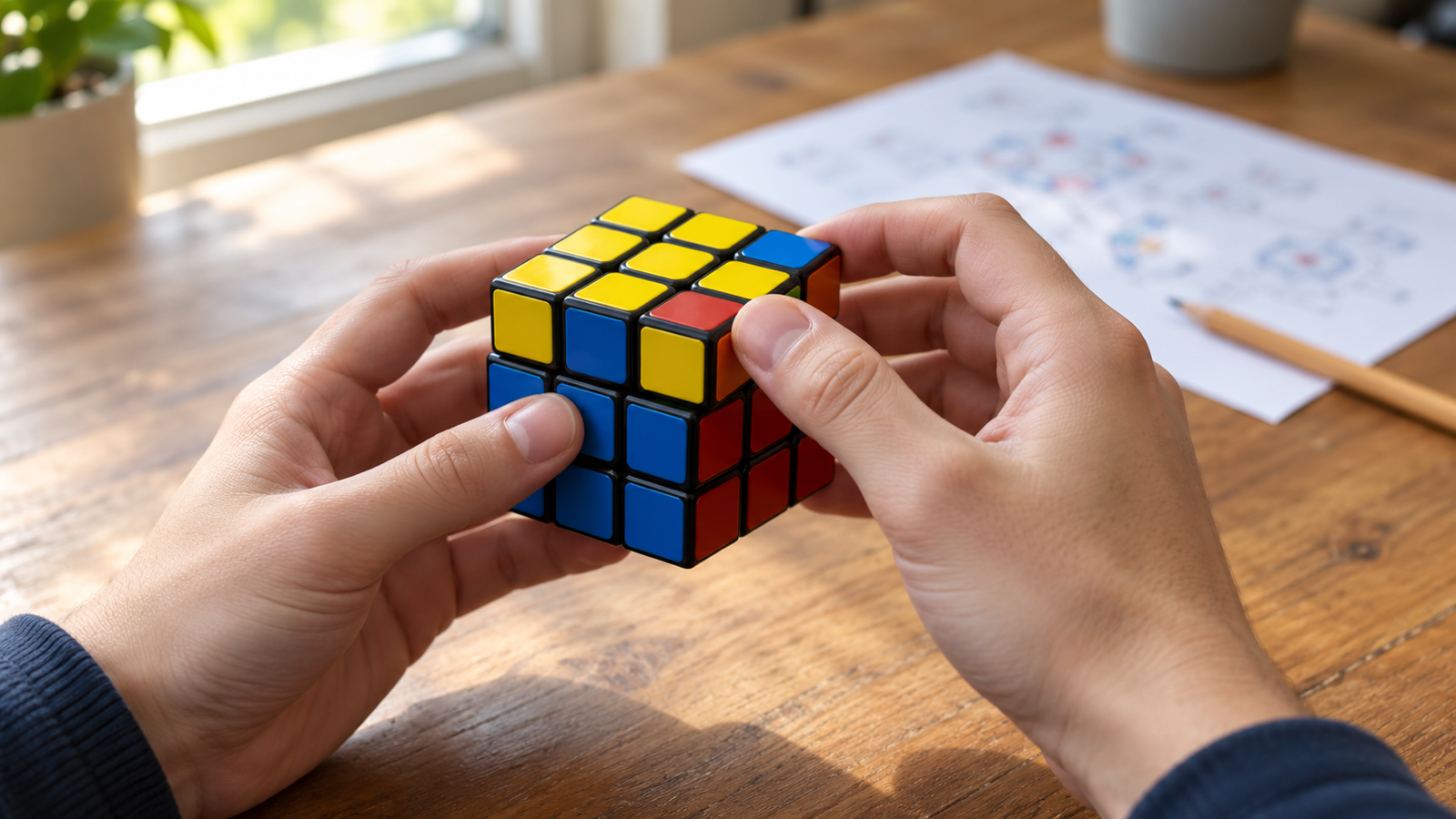
Finger tricks mean turning layers with individual fingers instead of re-gripping with your whole hand.
- U: push the back-right of the top layer with your right index finger. U’: same with the left index.
- R and R’: wrist turns, but keep your thumb on the front so you don’t re-grip.
- R U R’ U’: the most common trigger in cubing. Drill it until it’s one smooth motion; good cubers do it in well under a second.
- Hold the cube with white or yellow on top or bottom and avoid rotating the whole cube. Every y rotation is a pause.
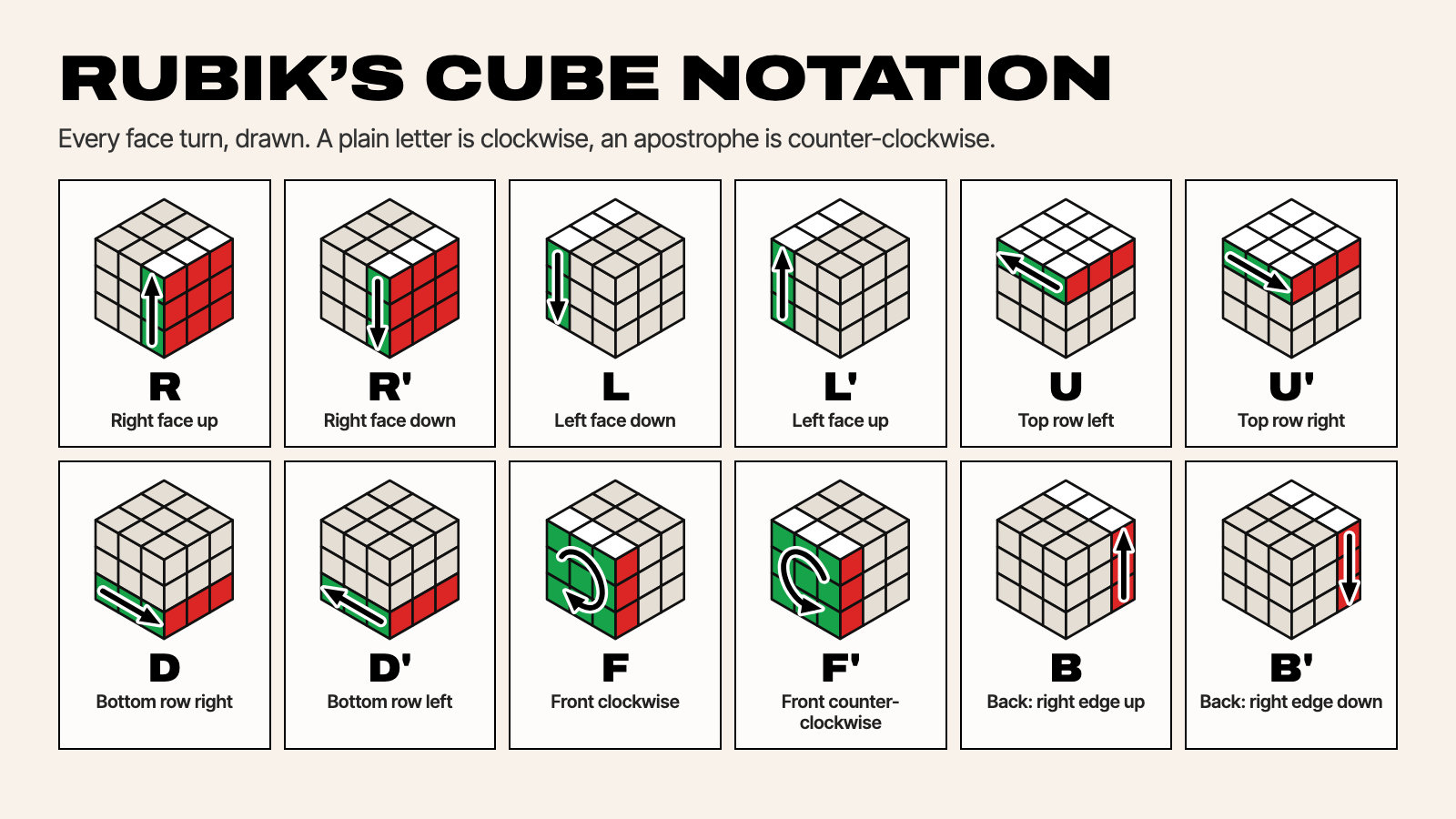
If the move letters slow you down, Rubik’s cube notation explained covers them in ten minutes.
Step 3: Solve the cross on the bottom
The beginner method builds the white cross on top, then flips the cube. Fast solvers build it directly on the bottom, so they never flip and can see the next pieces while finishing it. Any cross can be solved in 8 moves or fewer, so aim for that. It feels terrible for the first week because you can’t see what you’re doing. Push through: it’s the habit that unlocks everything after it.
Use your 15 seconds before the solve (the official inspection time) to plan the whole cross before you turn anything.
Step 4: Learn the 4-look last layer
The beginner last layer takes several looks and repeats the same algorithm many times. The 4-look last layer does it in four steps with roughly 16 short algorithms:
- Orient the edges (make the yellow cross) in one go: dot, L-shape or line, using F R U R’ U’ F’ and its variants.
- Orient the corners (all yellow on top): 7 cases, starting with Sune (R U R’ U R U2 R’) and Anti-Sune.
- Permute the corners: 2 cases, a pair of “headlights” or none.
- Permute the edges: 4 cases (the U-perms, H-perm and Z-perm).
Learn one case a day. Most people already know a few of these from the beginner method; our Rubik’s cube algorithms sheet shows the ones you have.
Step 5: Replace the first two layers with F2L
This is the big jump. Instead of placing four white corners and then four middle edges (eight separate jobs), F2L (“first two layers”) pairs each corner with its matching edge in the top layer and inserts the pair in one go. Four pairs, four jobs.
Learn it intuitively first: get the corner and edge next to each other on top, then put them into their slot with an R U R’ or L’ U’ L style insert. Full F2L has 41 cases with set algorithms, but you don’t need them to get under 30 seconds; understanding why the basic inserts work gets you most of the way.
Step 6: Practise look-ahead
Look-ahead means finding your next pair while your hands are still finishing the current one. It is the skill that separates a 25-second solver from a 15-second one, and it is trained by going slower, not faster:
- Do full solves at a pace where you never stop. If you pause, you’re going too fast.
- During the cross, glance at where the first F2L pair is.
- After each insert, your eyes should already be on the next pair.
How fast can you get, and how long does it take?
Rough, honest ranges for someone practising 20–30 minutes a day:
- Beginner method, first weeks: 1–3 minutes.
- Beginner method + finger tricks + speed cube: 50–70 seconds.
- Cross on the bottom + 4-look last layer: 35–50 seconds.
- Intuitive F2L + some look-ahead: under 30 seconds, usually within a few months.
- Full CFOP (all F2L, full OLL and PLL): sub-15 for dedicated cubers, after a year or more.
That method (cross, F2L, OLL, PLL) is CFOP, the one most speedcubers use. Roux is the main alternative with fewer algorithms, but if you learned the layer-by-layer beginner method, CFOP is the natural next step.
Practise with a solver and a timer
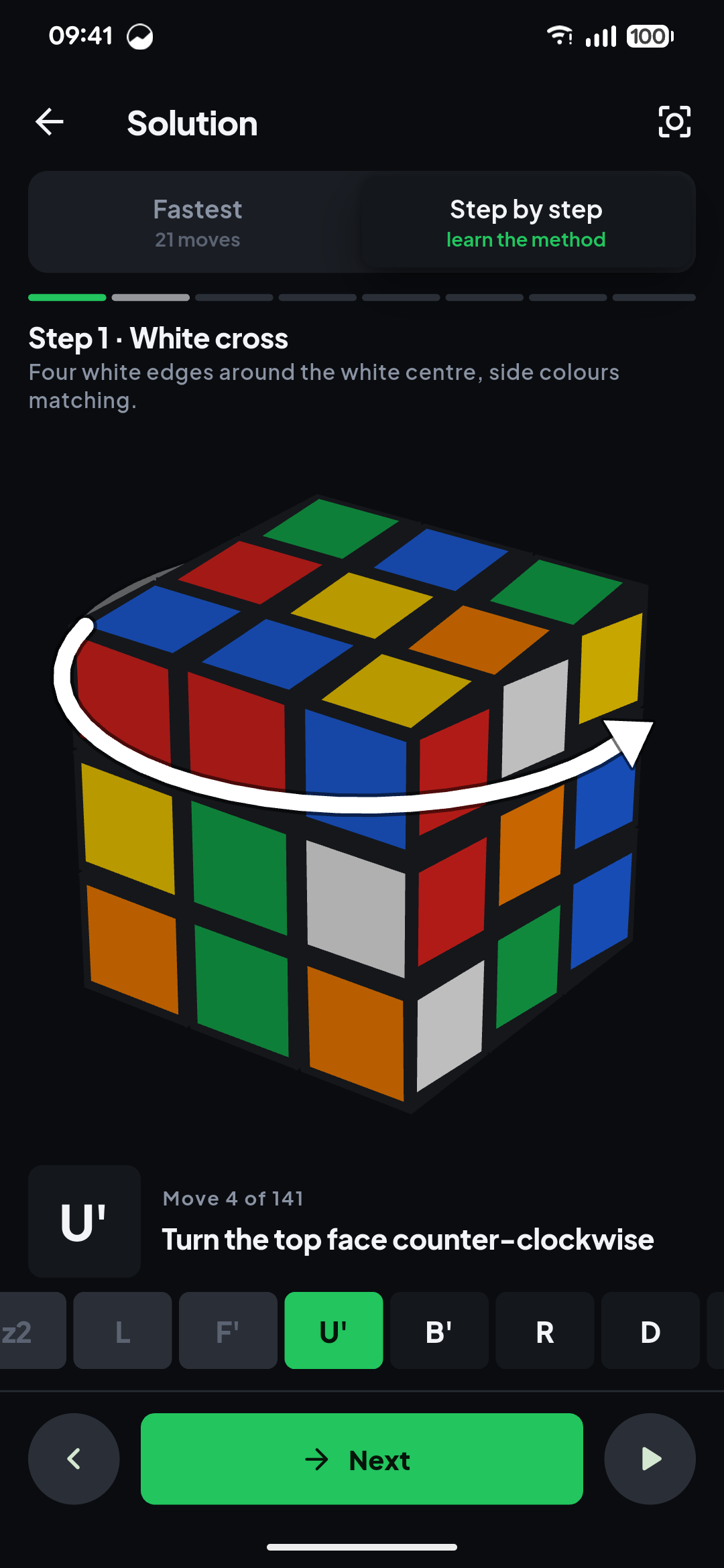
Cube Solver helps at both ends. When a scramble goes wrong or you can’t finish the last layer, scan the cube with your camera or tap in the colours, and it shows every move on a 3D cube with an arrow on the layer to turn: Fastest mode in about 20 moves, or Step by step to replay the beginner method on your own cube. The Timer tab gives you a fresh 20-move scramble each time, your best time, an average of 5 (best and worst dropped, like the official rules) and a full history, so you can see each step on this list actually pay off. It works offline, needs no account, and is free on Android with ads; one purchase removes them.
Common questions
What is the fastest way to solve a Rubik’s cube?
For humans, CFOP (cross, F2L, OLL, PLL) is the method most fast solvers use. For the fewest moves, a computer solver finds solutions of about 20 moves, which is far shorter than any method a person can memorise.
How do I get faster at solving a Rubik’s cube?
Get a magnetic speed cube, learn finger tricks, solve the cross on the bottom, switch to a 4-look last layer, then learn intuitive F2L. Track your average of 5, not your best single.
How many algorithms do I need to solve a Rubik’s cube fast?
About 16 for a 4-look last layer gets most people under 40 seconds. Full CFOP uses 78 last-layer algorithms (57 OLL, 21 PLL), but you can get under 30 seconds without them.
Is it better to turn faster or look ahead?
Look ahead. Most of a beginner’s time is spent pausing, not turning. Slow, pause-free solves improve your times faster than frantic ones.
How long does it take to get sub-30?
With 20–30 minutes of daily practice, a few months is typical after learning the beginner method.
From the studio
Previous Article
Cute Things to Say to Your Boyfriend: 80 Lines to Say in Person or Over Text
Next Article
How to Scan Documents on Android (Free, as a PDF)