Rubik’s Cube Notation Chart (Free PDF): What U2, R' and x Mean
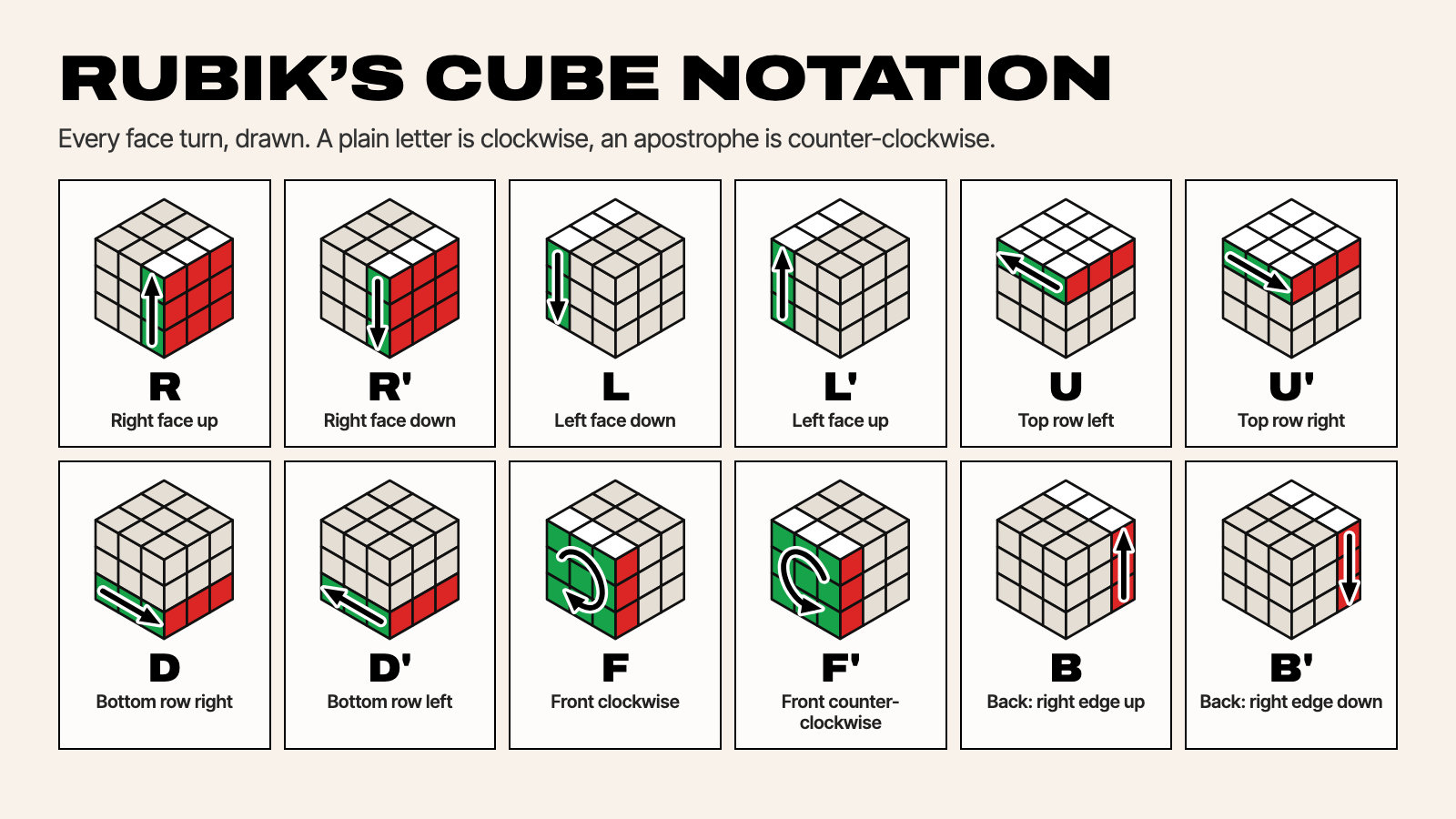
Rubik’s cube notation chart with all 20 moves drawn, from R and U2 to M, x and y, plus a free one-page PDF. What R U R’ U’ means, in plain English.
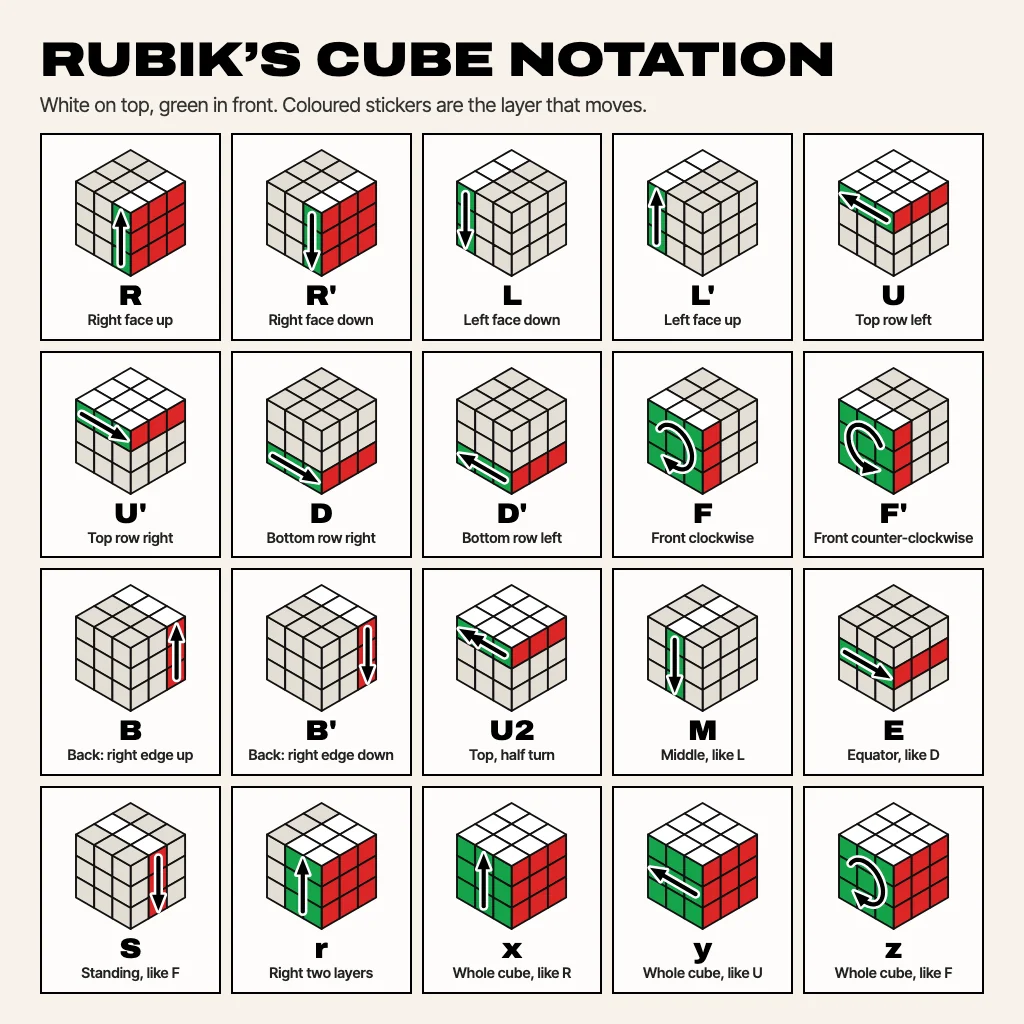
Rubik’s cube notation is one letter per face, named from where you sit: R (right), L (left), U (up), D (down), F (front) and B (back). A plain letter is a quarter turn clockwise as you look at that face, an apostrophe (R') is counter-clockwise, and a 2 (U2) is a half turn. The chart below draws all 20 moves you will meet, including the middle slices M, E and S and the whole-cube rotations x, y and z. Download the Rubik’s cube notation chart (free one-page PDF) to print and keep next to you while you practise.
Every Rubik’s cube tutorial eventually hands you something like R U R' U' and moves on as though it were obvious. It is not obvious. It is a compact language, and once you can read it, every algorithm on the internet becomes usable — including the ones for cubes you have never touched.
It takes about ten minutes to learn and it never changes. Here is all of it.
The six letters
Each letter is one face of the cube, named from where you are sitting:
- R — the Right face
- L — the Left face
- U — the Up face, the one pointing at the ceiling
- D — the Down face, against the table
- F — the Front face, pointing at you
- B — the Back face, pointing away
Notice what the letters are not: they are not colours. R does not mean red. Which face is “R” depends entirely on how you are holding the cube right now, which leads directly to the single most important rule in this article.
Once an algorithm starts, do not rotate the cube in your hands. Pick a grip, keep the same face pointing at you, and turn only the layers the letters name. The moment you spin the whole cube mid-sequence, every remaining letter means a different face and the algorithm quietly stops working. If a sequence “works sometimes”, this is almost always why.
Plain letter means clockwise
A letter on its own is a quarter turn clockwise — 90 degrees — of that face.
Clockwise measured how? As if you were looking straight at that face, nose to nose with it. For R, imagine standing at the right-hand side of the cube looking back at it; turn that face clockwise from there.
This works out intuitively for R, U and F, because you can more or less see those faces. It is completely counter-intuitive for the other three:
- B is clockwise as seen from behind the cube. From your seat, the back face appears to turn counter-clockwise.
- D is clockwise as seen from underneath. From above, it looks like it goes the other way.
- L is clockwise as seen from the left-hand side, which again is the reverse of what your right hand instinctively wants to do.
If you take one thing from this article, take that. B and D backwards is the most common cube mistake there is, and it fails in a particularly nasty way: the algorithm runs, the cube changes, nothing looks obviously broken, and three steps later the solve has fallen apart.
A trick that helps while you are learning: physically turn the cube so the face you are about to move is pointing at you, work out which way clockwise is, turn it back, then make the move.
The prime: R'
An apostrophe after a letter — written R' and read aloud as “R prime” — means the same quarter turn counter-clockwise.
So R and R' undo each other. Do R then R' and you are exactly where you started. You will sometimes see the same idea written as Ri or R- in older guides, and as a small anticlockwise arrow in printed instructions. All identical.
The double: U2
A 2 after a letter means a half turn, 180 degrees.
Direction does not matter here, which is the nice part: U2 and U2' end in the same place, so nobody writes the second form. Turn it twice, whichever way is comfortable. Speedcubers do care, because the direction affects the hand movement that comes next, but for solving purposes it is genuinely free choice.
Slices: M, E and S
These turn the middle layer — the slice between two opposite faces, with no outside face moving. They appear in a lot of pattern algorithms and in more advanced methods.
- M — the Middle slice, between L and R. It follows the direction of L.
- E — the Equator slice, between U and D. It follows the direction of D.
- S — the Standing slice, between F and B. It follows the direction of F.
The direction rule is the whole difficulty. M going the same way as L, not R, catches people out constantly — and there is no logic to rescue you, it is simply the convention. Primes and 2s work exactly as before: M', E2, and so on.
Slice moves also do something no face turn does: they move the centres. That is not a problem, but it does mean the cube can end up solved-but-rotated, with the colour arrangement intact and the whole thing turned in your hands.
Rotations: x, y and z
Lower-case x, y and z mean turn the entire cube, all three layers together. Nothing is scrambled or solved by them; they just change your point of view, and they are how a written algorithm tells you to change grip.
- x — roll the whole cube in the direction of R (the front face goes up)
- y — spin the whole cube in the direction of U (the front face goes left)
- z — tip the whole cube in the direction of F (the top face goes right)
Each takes a prime or a 2 like anything else. Solving guides often open with something like z2, which simply means “flip the cube over so what was on top is now on the bottom”.
Wide moves: r, u, f
A lower-case face letter — or the same letter with a w, as in Rw — means a wide turn: that face plus the middle layer behind it, two layers at once.
So r equals R plus M turning together. You will rarely need these on a 3x3 beginner solve, but they are everywhere in 4x4 and 5x5 algorithms, where extra inner layers exist and have to be addressed separately.
How to read an algorithm
Left to right, one move at a time, with no pauses to reinterpret. Take R U R' U':
- R — right face, quarter turn clockwise
- U — top face, quarter turn clockwise
- R' — right face, quarter turn counter-clockwise
- U' — top face, quarter turn counter-clockwise
Those four moves are the most famous sequence in cubing — often called the “sexy move” — and they are the engine of step 2 of the beginner method.
Here is a satisfying way to prove to yourself that you are reading it correctly. Take a solved cube and run R U R' U' six times in a row. If your notation is right, the cube returns to solved. If it does not, one of your four moves is going the wrong way — and now you know before it costs you a solve.
Inverting an algorithm
Useful, and simpler than it sounds. To undo any sequence, reverse the order and flip every prime. Plain letters get an apostrophe, primed letters lose theirs, and 2s stay as they are.
So the inverse of R U R' U' is U R U' R'. The inverse of F R U R' U' F' is F U R U' R' F'.
This is how a solver turns a scramble into a solution in the crudest possible way, and it is genuinely handy at the table: if you run an algorithm from the wrong position and want to back out, invert it rather than guessing.
Reading a scramble
A scramble is just a long algorithm, usually about twenty moves, printed as one line:
R2 D B' F D U B R2 B2 R' D' L' F B' D' L2 F L2 F' R'
Apply it to a solved cube, in order, with white on top and green facing you unless told otherwise, and you get the position the scramble describes. This is how competitions guarantee everyone solves the same cube, and how a timer app can compare your times fairly from one solve to the next.
The five mistakes that cause almost all failures
- Rotating the cube mid-algorithm. Same grip from first letter to last. Nothing else fixes this.
- B turned the wrong way. Clockwise from behind, which looks backwards from your chair.
- D turned the wrong way. Clockwise from underneath, same trap.
- M following R. It follows L. There is no reason; it is just the convention.
- Half-remembering a long algorithm. A sequence executed at 90 percent accuracy is not 90 percent as good — it scrambles the cube. Read each move, then make it.
The fastest way to make it stick
Notation is muscle memory, not knowledge. You will not learn it by reading this page; you learn it by making about fifty turns while checking each one.
The Learn tab in Cube Solver: Scan & Solve 3D is a deck of cards for exactly that — one card per symbol, each with the turn animated on a 3D cube you can watch from any angle, and B shown from the left so you can actually see it happen. Swipe right when it clicks, left to see it again, and the ones you swipe left come back around.
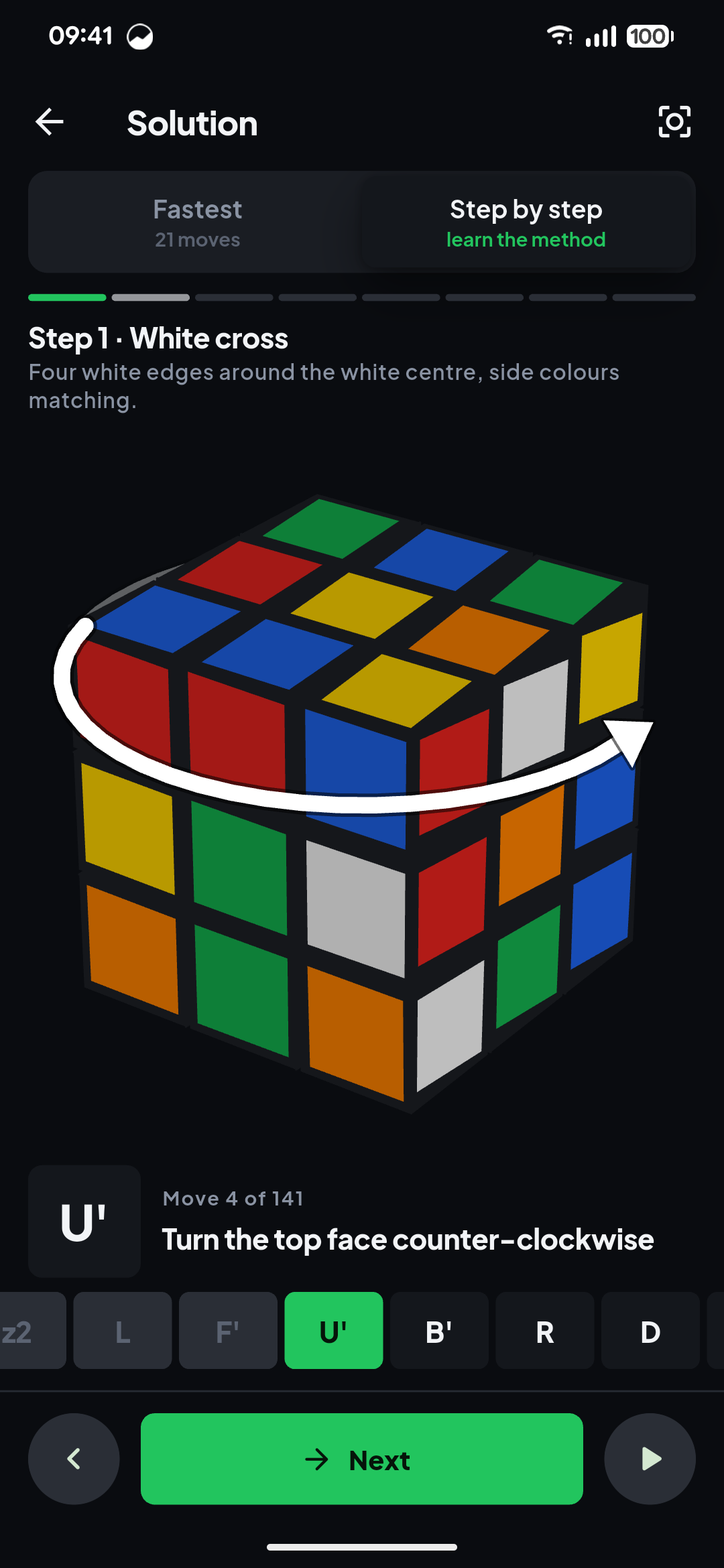
Then it goes straight to work: solve a real cube in the app and every move of the solution is shown as its symbol and as an animated turn with an arrow drawn round the layer that moves, so you are reading notation while doing the thing it describes. That is the loop that makes it permanent. It is free and works offline.
Common questions
Is there a Rubik’s cube notation PDF?
Yes. Our Rubik’s cube notation chart PDF is free, one A4 page, and draws all 20 moves with the rules, the common traps and how to undo an algorithm. It prints fine on US Letter too.
What does U2 mean in Rubik’s cube?
U2 means turn the Up face (the top layer) a half turn, 180 degrees. Either direction is fine, because two quarter turns clockwise and two counter-clockwise end in the same place. The same goes for R2, F2, D2 and every other letter followed by a 2.
What is U in Rubik’s cube notation?
U is the Up face, the layer pointing at the ceiling. A plain U turns it a quarter turn clockwise as you look down on it, which moves the front stickers of the top row to the left. U' turns it the other way.
What is the meaning of R U R' U' on a Rubik’s cube?
R U R' U' is four moves: right face clockwise, top clockwise, right face counter-clockwise, top counter-clockwise. It is the most used sequence in cubing, nicknamed the “sexy move”, and it is what drops the white corners into place in the beginner method. Run it six times on a solved cube and the cube comes back solved.
What is x in Rubik’s cube?
A lower-case x is not a turn at all: it means rotate the whole cube in the direction of R, so the front face goes up and the bottom comes to the front. x' rolls it the other way, and x2 flips it end over end.
What is y in Rubik’s cube algorithms?
y rotates the whole cube in the direction of U, so the right face comes round to the front. Algorithms use y and y' to tell you to look at a different side before the next move. z tips the whole cube the way F turns.
What is B in Rubik’s cube?
B is the Back face, the side pointing away from you. Clockwise is judged from behind, so from your seat a B turn looks counter-clockwise: the top row of the back moves to the left as you look at the cube from the front. Getting B backwards is the most common notation mistake.
What are the Rubik’s cube sides called?
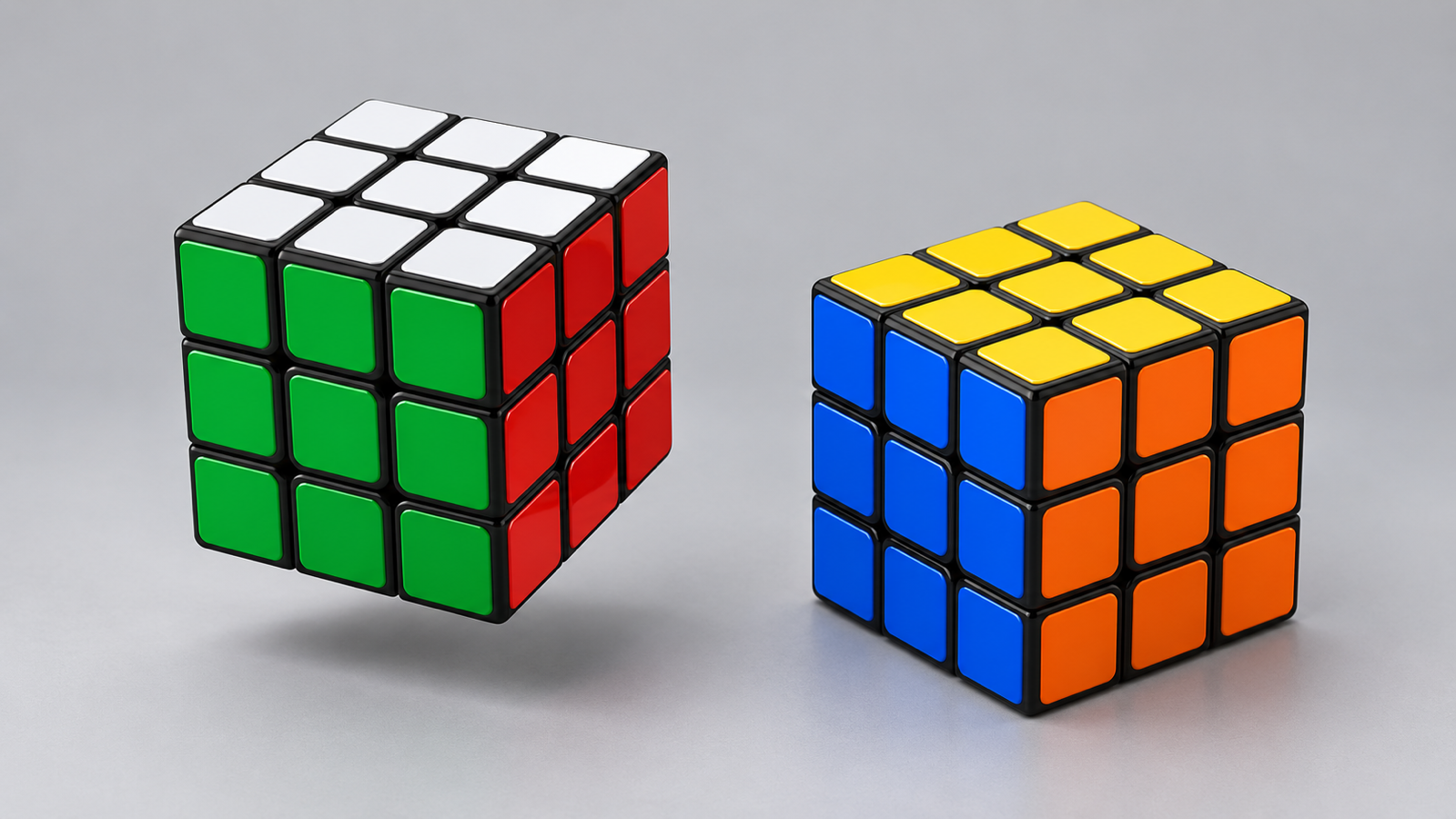
The six sides are named by position, not colour: Up, Down, Front, Back, Left and Right, written U, D, F, B, L and R. On a standard cube white is opposite yellow, green opposite blue and red opposite orange; see Rubik’s cube sides and colors for the full layout.
The short version
Six letters for six faces, from your point of view. Plain means clockwise looking at that face, an apostrophe means counter-clockwise, a 2 means a half turn. Lower case or a w means two layers, M, E and S mean the middle slice, and x, y, z turn the whole cube. Keep the same grip for the whole algorithm, and remember that B and D are clockwise as seen from the far side.
Next: the beginner method in seven steps, which uses six algorithms and nothing you have not just learned to read, or keep the Rubik’s cube algorithms sheet open while you practise.
From the studio
Previous Article
How to Solve a Rubik’s Cube: The Beginner Method in 7 Steps
Next Article
Invalid Scramble Meaning: Why Your Cube Solver Says the Cube Is Unsolvable