Rubik’s Cube Sides Colors: Face Names, Order and Opposite Colors
Rubik’s cube sides and colors explained: the six face names (U, D, F, B, L, R), which colors are opposite, the standard color order, and why your sides don’t match.
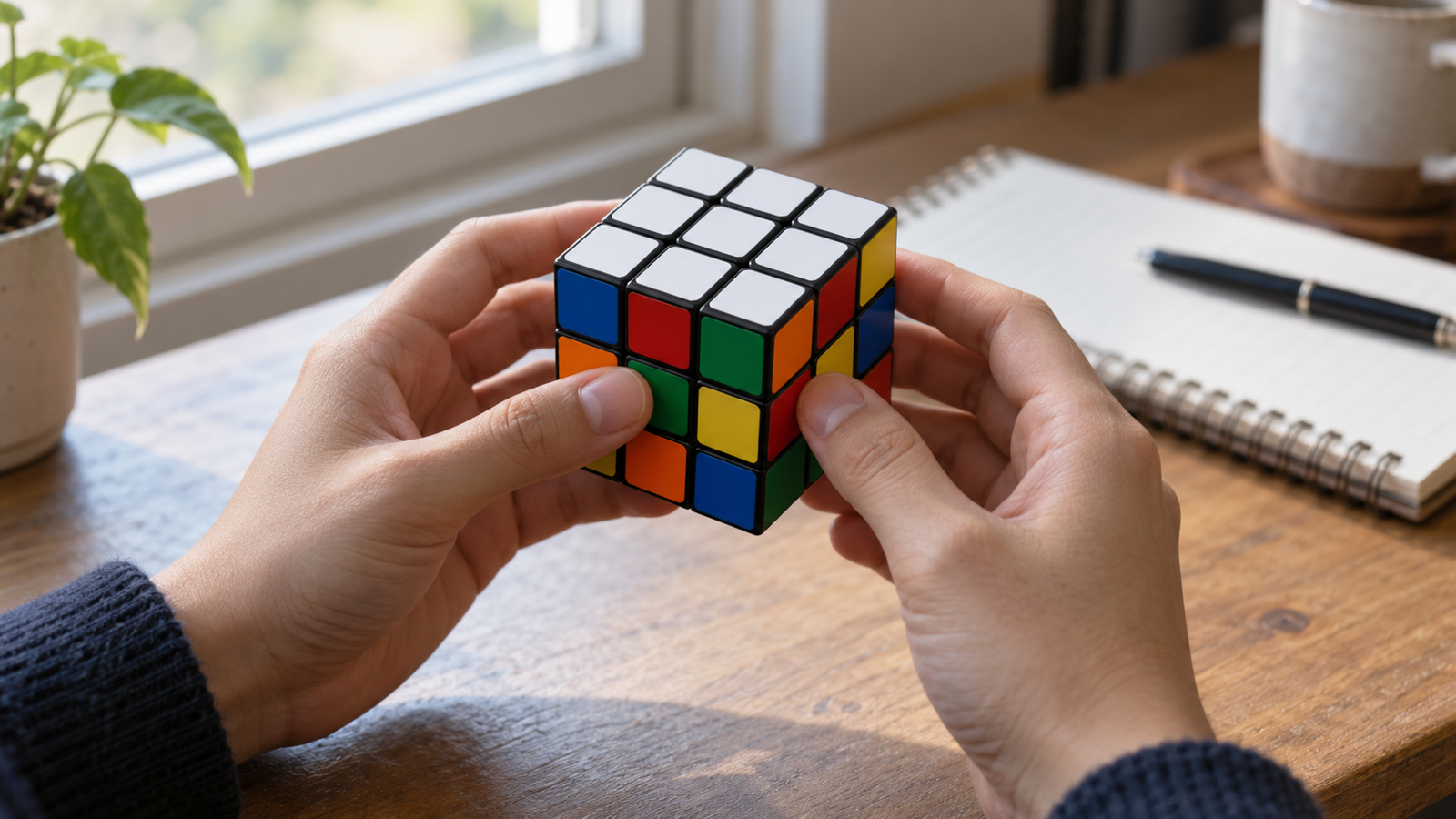
A standard Rubik’s cube has six sides and six colors: white, yellow, green, blue, red and orange. The colors always sit in the same places relative to each other: white is opposite yellow, green is opposite blue, and red is opposite orange. Knowing that, and the names for each side, makes every tutorial and solver easier to follow.
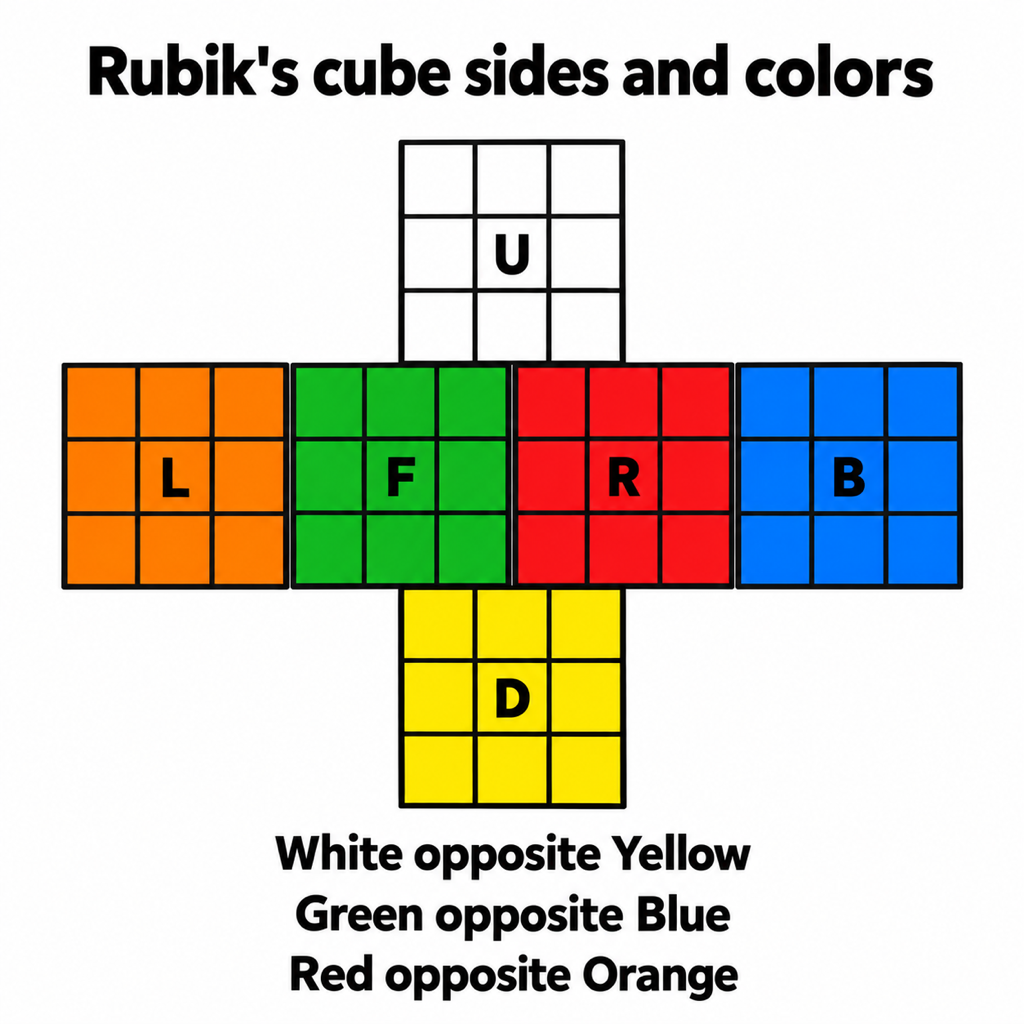
Rubik’s cube sides names
The sides are named by position, not by color, from where you’re holding the cube:
- U (Up): the top face
- D (Down): the bottom face
- F (Front): the face pointing at you
- B (Back): the face pointing away
- L (Left) and R (Right)
So “R” is whichever face is on your right at the moment, whatever its color. These letters are the whole basis of cube notation; see Rubik’s cube notation explained for how they become moves like R U R' U'.
Rubik’s cube opposite colors
On the standard (“Western”) color scheme used by Rubik’s-brand cubes and nearly every speed cube:
- White is opposite yellow
- Green is opposite blue
- Red is opposite orange
An easy way to remember it: the two colors that look most alike always face away from each other. White and yellow are the two light ones, red and orange the two warm ones, and green and blue the two cool ones.
Rubik’s cube sides order (the standard orientation)
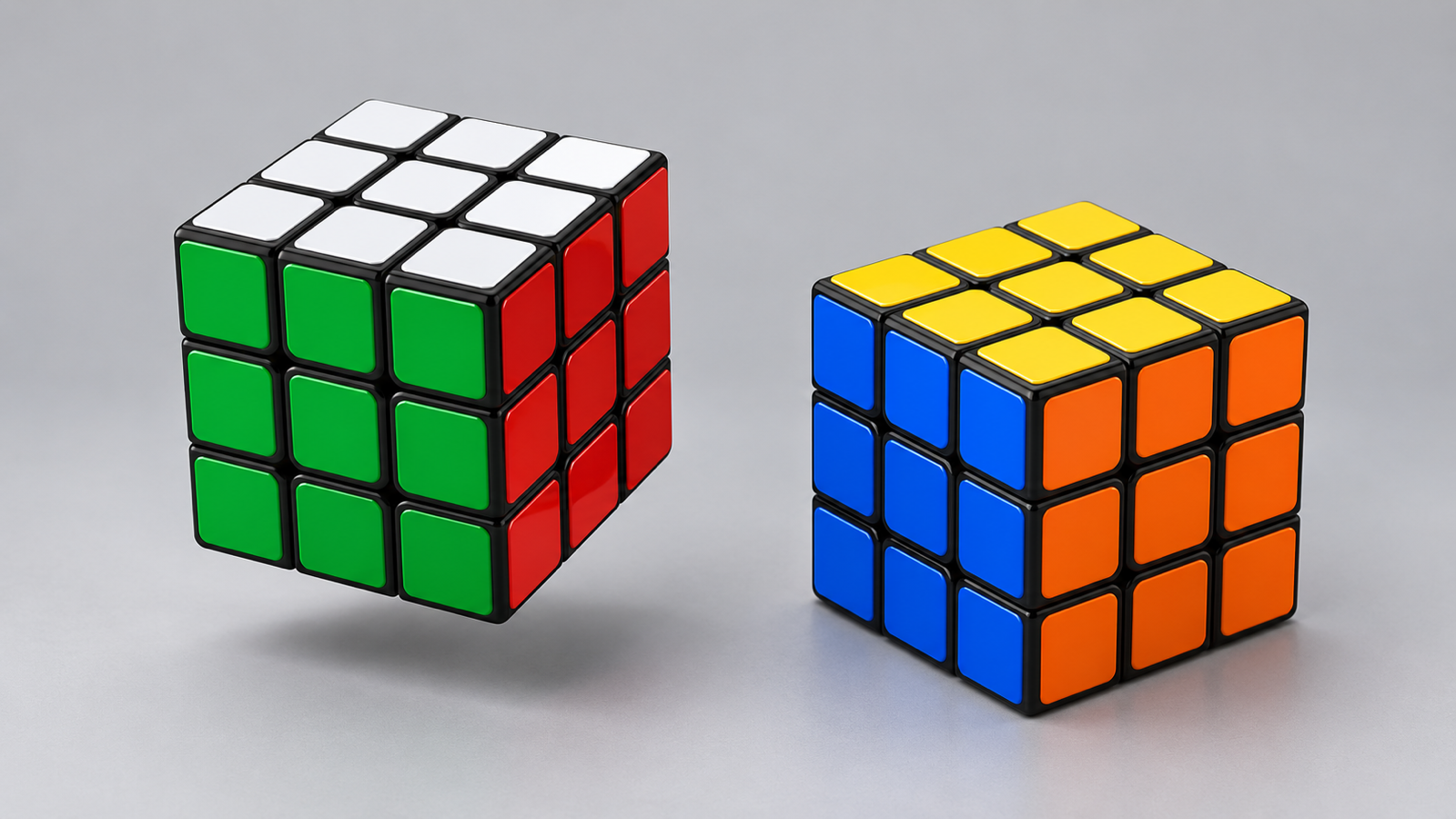
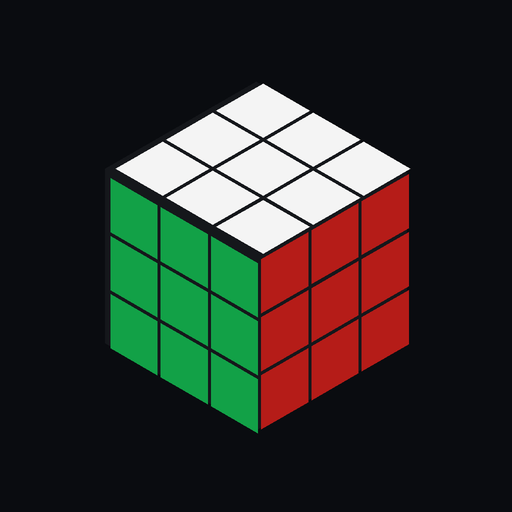
Tutorials, scramble sheets and solvers usually assume you hold the cube with white on top and green in front. Then:
- Red is on the right
- Orange is on the left
- Blue is at the back
- Yellow is on the bottom
Cubers call this scheme BOY: blue, orange and yellow go clockwise around the corner where they meet. Check it on your own cube: find the corner where those three meet, and they should read blue, orange, yellow going clockwise.
Why the colors never move
A 3x3 is 26 visible pieces: 6 centres (one color each), 12 edges (two colors) and 8 corners (three colors). The six centres are fixed to the core and never change position relative to one another. That’s why the opposite pairs are permanent, and why the centre sticker, not the corners, tells you what color a face will be when it’s solved.
It also gives you a quick check on a cube that won’t solve: count the stickers. There must be exactly nine of each color, and no edge or corner can have two colors that belong on opposite faces (a white-yellow edge is impossible). If you find one, stickers have been swapped, and our guide to why a cube solver says unsolvable explains the fix.
Other color schemes
Some cubes, mostly older Japanese ones, use a different scheme where white is opposite blue instead of yellow. They solve exactly the same way; only the pairs differ. If a solver app keeps rejecting a cube you scanned correctly, check which scheme your cube uses.
2x2 and 4x4 cubes use the same standard colors. A 2x2 has no centres, so you orient it from a corner instead.
Common questions
What are the 6 colors on a Rubik’s cube?
White, yellow, green, blue, red and orange.
What color is opposite red on a Rubik’s cube?
Orange. The other pairs are white and yellow, and green and blue.
What is the correct order of colors on a Rubik’s cube?
With white on top and green in front: red on the right, orange on the left, blue at the back and yellow underneath.
Why are my Rubik’s cube sides not matching?
If one face is a single color but the stickers around its edges are mixed, you’ve solved a face, not a layer. The row below each edge has to match its own centre too. See what to do after the white face for how to fix it.
How do I scan a cube into a solver app?
Hold it in the standard orientation and scan each face in the order the app asks. Cube Solver: Scan & Solve 3D checks each centre color as you scan, so a face held the wrong way round is caught straight away.
The short version
Six sides named U, D, F, B, L, R by position. Six colors in three fixed pairs: white–yellow, green–blue, red–orange. Hold white on top and green in front, and red is on your right.
From the studio
Previous Article
Party Games for Adults on Phone: The Best Mobile Party Games for Adults (18+)
Next Article
Rubik’s Cube After White Face: What to Do Once You Have the White Side