Rubik's Cube Patterns: 8 Easy 3x3 Patterns, Step by Step
8 Rubik's cube patterns for a 3x3 with the exact moves: checkerboard, six spots, plus signs, cube in a cube, anaconda, superflip and more, easiest first.
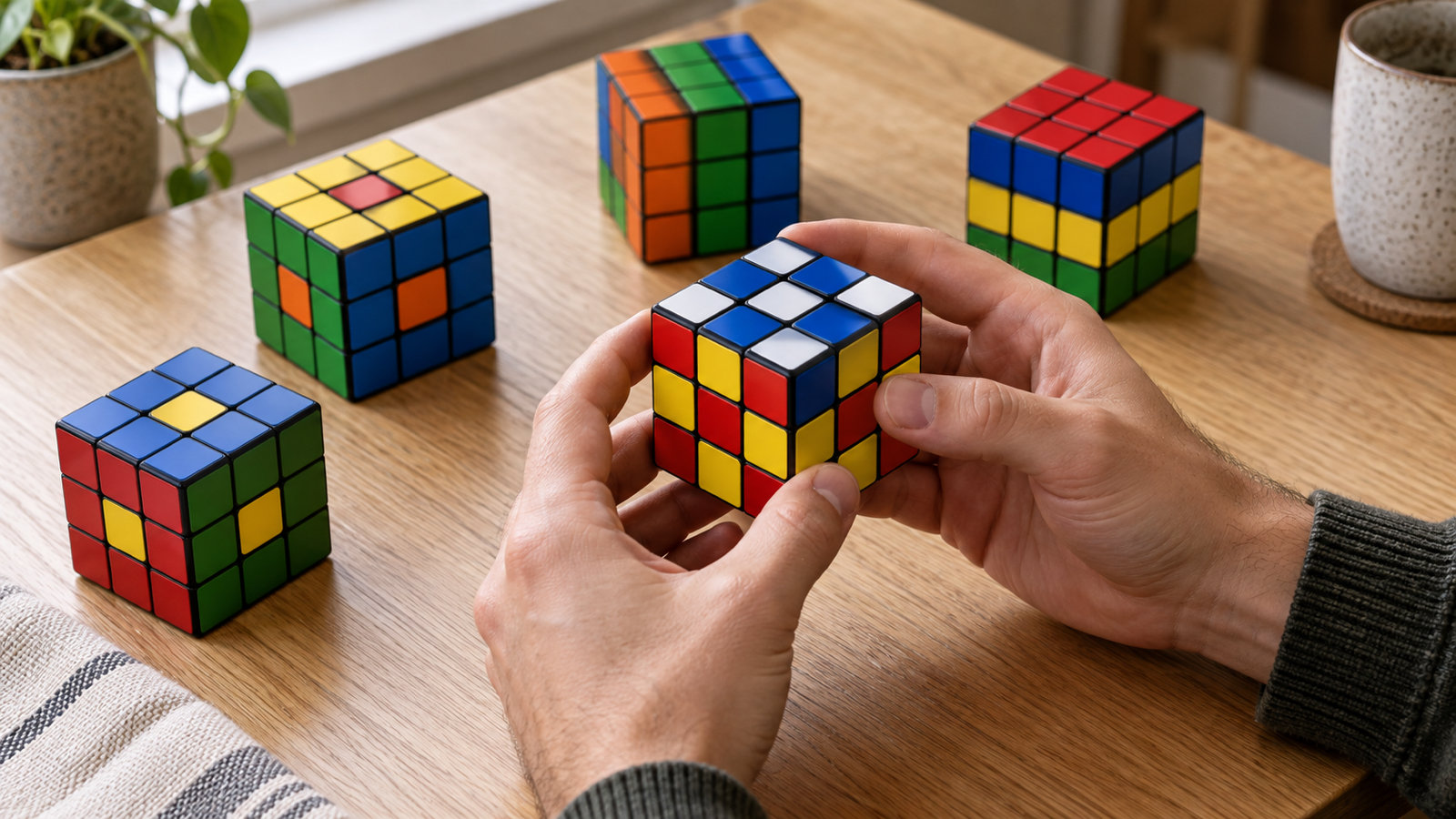
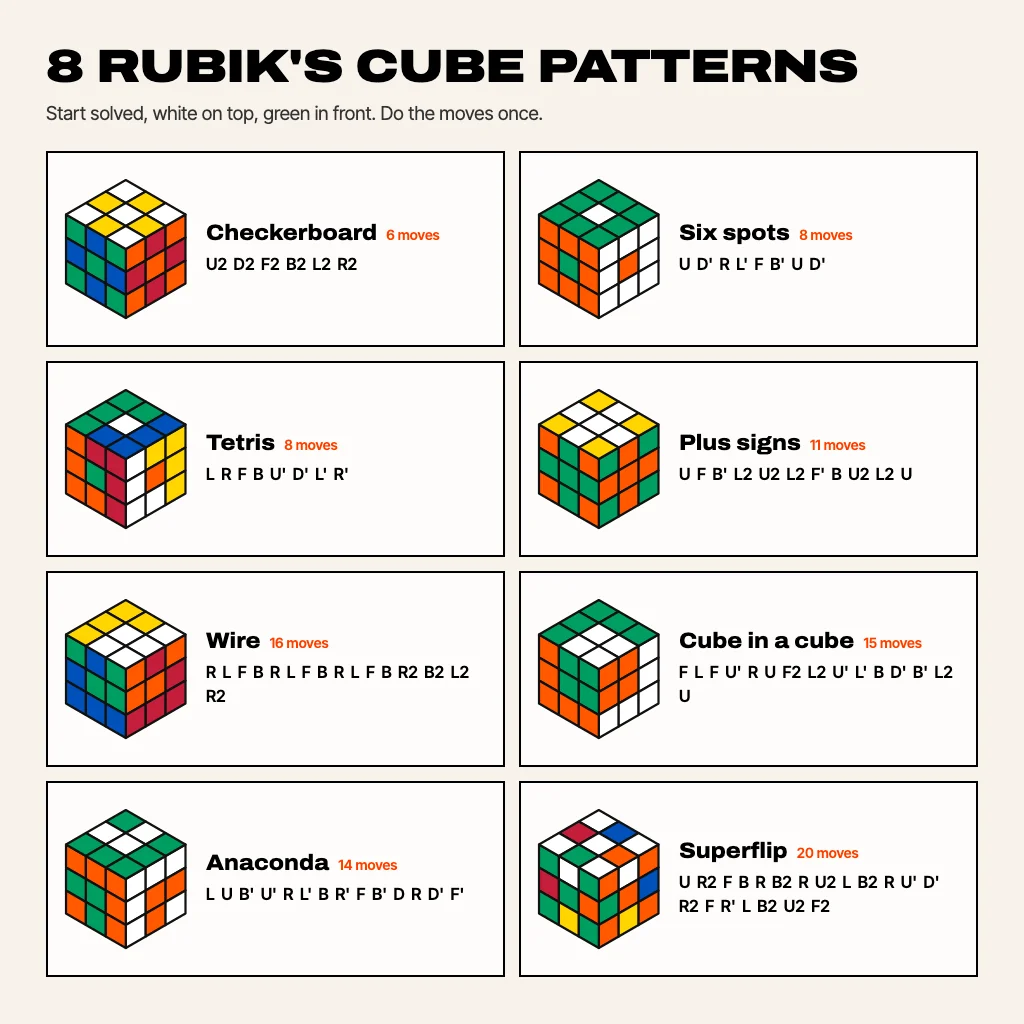
A Rubik's cube pattern is a short sequence of moves that turns a solved 3x3 into a picture: a checkerboard, a spot in the middle of every face, a cross on every side, a small cube inside the big one. The easiest is the checkerboard, U2 D2 F2 B2 L2 R2, six half turns from solved. Below are eight patterns, easiest first, with the exact moves, how many there are and what the cube should look like. Start from a solved cube every time: white on top, green facing you.
How to read the moves
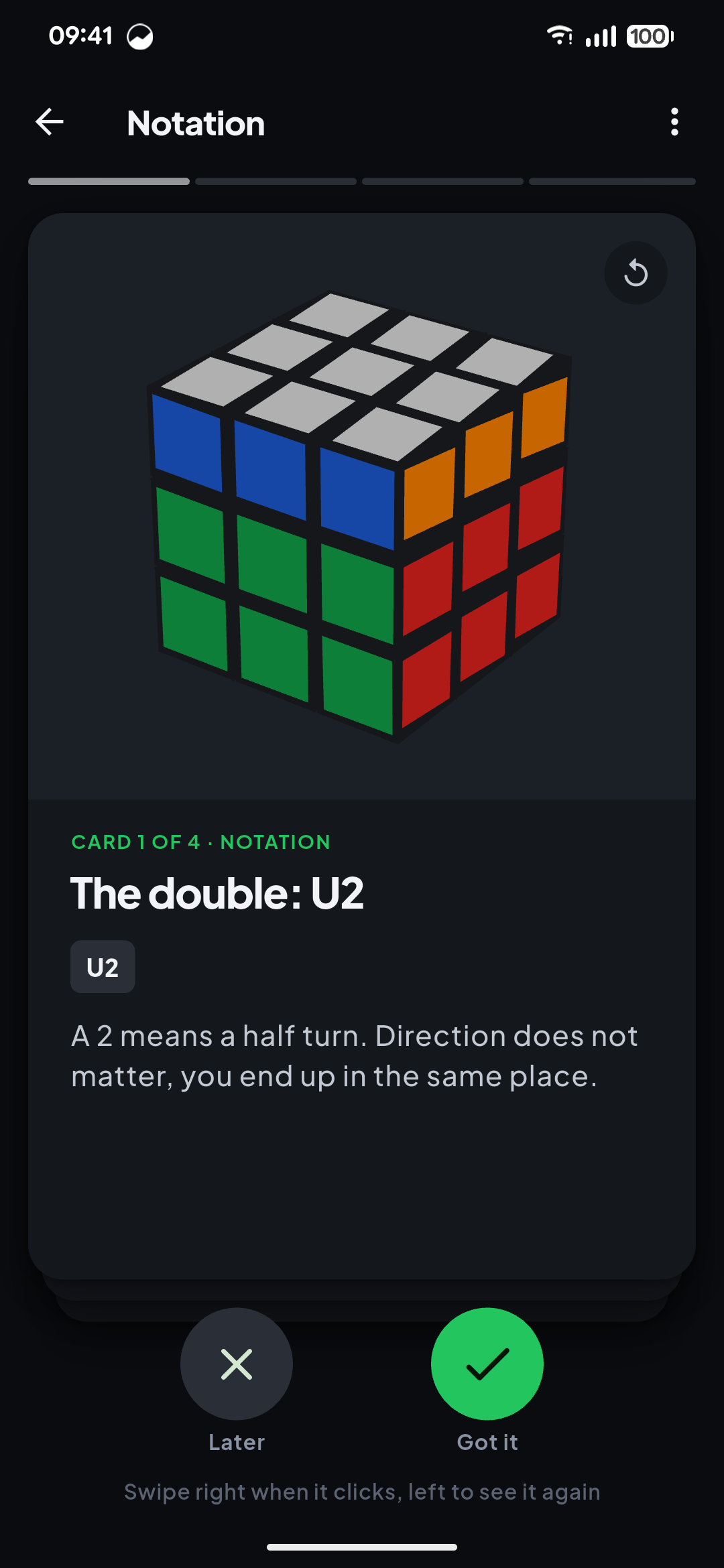
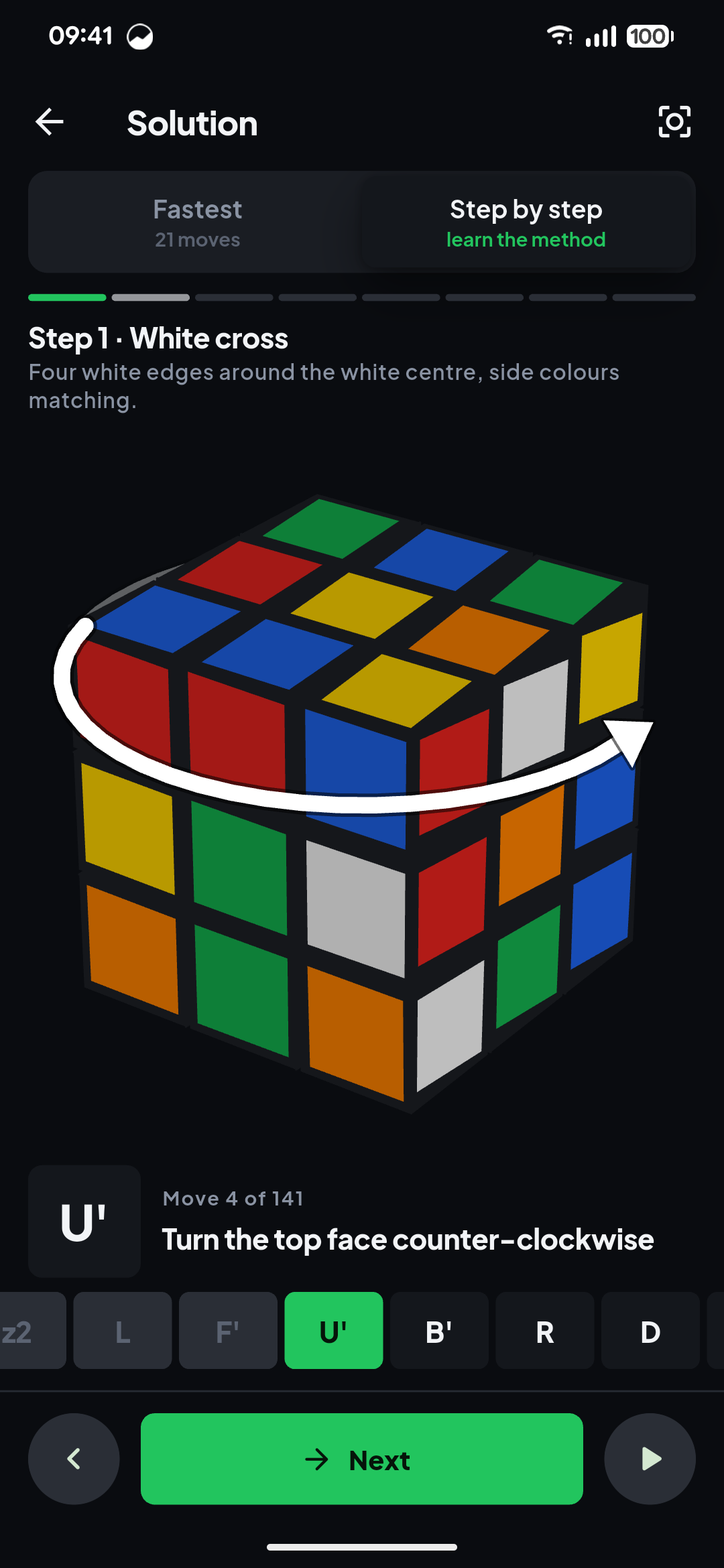
Each letter is a face, turned a quarter clockwise as you look straight at that face: U up, D down, F front, B back, L left, R right. An apostrophe (R') means anticlockwise, and a 2 (U2) means a half turn. Hold the cube the same way the whole time and do not turn the whole cube between moves. If any of this is new, Rubik's cube notation explained covers it with pictures.
1. Checkerboard (6 moves)
U2 D2 F2 B2 L2 R2
Every face becomes a checkerboard of its own colour and the opposite colour: white and yellow on top, green and blue in front, red and orange on the right. It only uses half turns, so it is the easiest pattern on the cube and the one to try first. Do the same six moves again and the cube is solved.
2. Six spots (8 moves)
U D' R L' F B' U D'
Each face is one solid colour except its centre, which wears a different colour: a "spot" in the middle of all six sides. The moves come in pairs of opposite faces turned opposite ways, which is why it moves only the centres relative to everything else.
3. Tetris (8 moves)
L R F B U' D' L' R'
Eight quarter turns leave each face looking like stacked, falling blocks. It is a good one for practising quick, accurate quarter turns.
4. Plus signs (11 moves)
U F B' L2 U2 L2 F' B U2 L2 U
A cross of one colour on every face, with the four corners in another colour. Sometimes called "cross" or "plus" pattern; it is the most requested pattern after the checkerboard.
5. Wire (16 moves)
R L F B R L F B R L F B R2 B2 L2 R2
Thin lines of a second colour run across four faces, like wire wrapped round the cube. It looks long, but it is the same four moves (R L F B) three times, then four half turns, so it is easy to remember.
6. Cube in a cube (15 moves)
F L F U' R U F2 L2 U' L' B D' B' L2 U
A small 2x2x2 cube appears to sit in one corner of the big one, in different colours from the rest. The 15 moves have no repeating rhythm, so go slowly the first time and check each turn. A longer version, cube in a cube in a cube, adds a third, even smaller cube.
7. Anaconda (14 moves)
L U B' U' R L' B R' F B' D R D' F'
A long strip of colour winds across the faces like a snake. Snake-style patterns (anaconda, python, the "snake") are all related; this is the shortest of them.
8. Superflip (20 moves)
U R2 F B R B2 R U2 L B2 R U' D' R2 F R' L B2 U2 F2
Every corner is solved and every edge is in the right place but flipped, so each face shows its colour with the edges turned the wrong way round. It looks simple, but it is famous: the superflip was the first position proven to need 20 moves to solve, and no 3x3 position needs more than 20.
How to undo a pattern
The checkerboard undoes itself if you repeat the same six moves. Every other pattern undoes if you do its moves backwards with every direction reversed: read the algorithm from the end, and turn R into R', R' into R, while half turns stay the same. For Tetris, that gives R L D U B' F' R' L'.
If the pattern goes wrong halfway, the reverse trick will not help because you do not know where you slipped. Scan the cube into a solver and start again from solved; see how to solve a Rubik's cube if you would rather fix it by hand.
Why the pattern does not look right
- You did not start from solved. Every pattern here assumes a solved cube.
- You turned the whole cube. Keep white on top and green in front from the first move to the last.
- A prime went the wrong way.
R'is anticlockwise as you look at the right face, which means the front of the right layer moves down. - Your cube has a different colour scheme. Some cheaper cubes swap colours. The shape of the pattern is the same; only the colours differ.
Patterns in Cube Solver
Cube Solver: Scan & Solve 3D has a Patterns track with six of these (checkerboard, cube in a cube, six spots, Tetris, plus signs and superflip). Each lesson plays the moves on a 3D cube, one turn at a time, so you can follow along on the cube in your hands. And if a pattern goes wrong, scan the cube with the camera and it shows you every move back to solved. It works offline, with no account.
Learning to solve as well? These patterns use the same notation as the beginner algorithms, so they are good practice for the real solve.
Common questions
What is the easiest Rubik's cube pattern?
The checkerboard: U2 D2 F2 B2 L2 R2. Six half turns from a solved cube, and the same six moves undo it.
How do you make a checkerboard on a Rubik's cube?
Start solved and turn each face a half turn in this order: up, down, front, back, left, right (U2 D2 F2 B2 L2 R2).
What is the cube in a cube pattern?
A pattern where a small 2x2x2 cube seems to sit in one corner of the 3x3. The moves are F L F U' R U F2 L2 U' L' B D' B' L2 U, 15 in total.
What is the superflip?
The position where every edge is flipped and everything else is solved. It takes 20 moves and was the first position proven to need the maximum of 20 moves to solve.
Do these patterns work on a 2x2?
No. They are written for a 3x3; several rely on the centre pieces, which a 2x2 does not have.
From the studio
Previous Article
Winter Arc Time Table (Free PDF for Students and Workers)
Next Article
Winter Arc Diet Plan: What to Eat for Weight Loss or Weight Gain