
Winter Arc Workout Plan: A 5-Day Split You Can Do at Home or the Gym
A free winter arc workout plan for the full 92 days: a 5-day split, the home version with no equipment, and how to progress it across the three months.
A winter arc runs 92 days, which is long enough that the plan you pick matters less than whether you can still run it in week nine. Five sessions a week, four of them lifting and one of them walking, beats six perfect sessions you abandon in November. Here is the split, the no-equipment home version, and how to progress it so December is not just October repeated.
Why five days and not six or seven
Five is the number that has slack built into it. A seven-day rule breaks the first time you get ill, travel or have a genuinely terrible day, and the break reads as failure. A five-day rule absorbs two bad days a week without anything technically going wrong, which means the streak survives the ordinary chaos of October to December — and the streak is the thing producing the result, not any individual session.
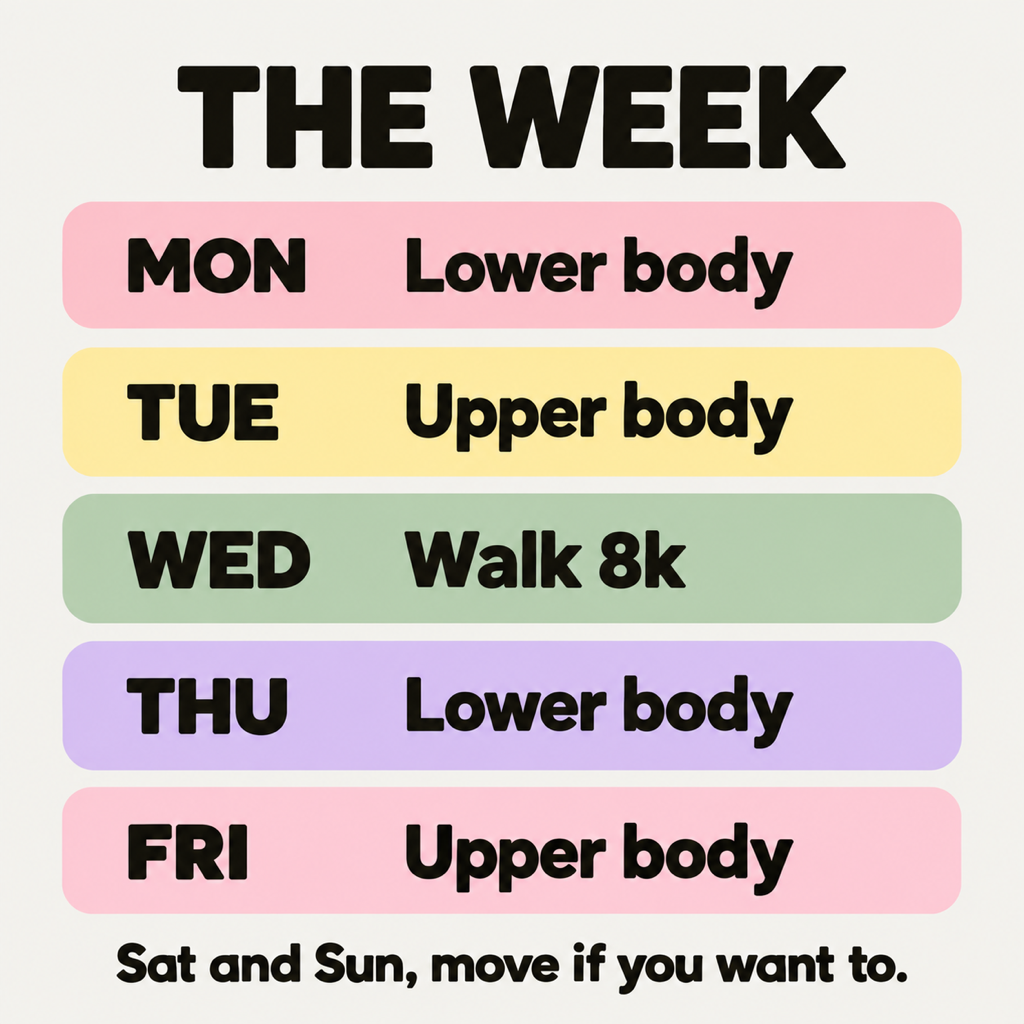
The 5-day split
- Monday — Lower body. Squat or goblet squat, Romanian deadlift, split squat, hip thrust, calf raise.
- Tuesday — Upper body. Dumbbell press, row, shoulder press, lat pulldown or pull-up, a curl and a triceps movement.
- Wednesday — Walk. Eight thousand steps or forty-five minutes outside. This is a session, not a rest day, and it ticks the box.
- Thursday — Lower body. Deadlift or hinge, leg press, lunge, hamstring curl, abs.
- Friday — Upper body. Incline press, row variation, lateral raise, face pull, arms.
- Saturday and Sunday — optional. Move if you want to. Do not add a rule here.
Three to four sets per movement, eight to twelve reps for most of it, and stop each set with one or two reps left rather than grinding to failure. Sessions should run forty-five to sixty minutes. If they are running ninety, you are resting too long, not working harder.
The home version, no equipment
Same structure, same five days. Bodyweight progresses by slowing the lowering phase and adding reps rather than adding weight.
- Lower: bodyweight squat, reverse lunge, glute bridge, single-leg glute bridge, wall sit, calf raise on a step.
- Upper: press-ups (incline on a sofa or counter if needed), pike press-up, a towel row on a door frame, superman, tricep dip off a chair.
- Walk day: unchanged. This is the one that needs nothing.
One pair of adjustable dumbbells or a set of resistance bands moves the home version from adequate to genuinely good, and is the only purchase worth making before day one. Everything else can wait until you have proved to yourself you will still be doing this on day forty.
How to progress it over 92 days
Running the same weights for three months is the most common mistake in a long challenge, and it is why people finish disappointed despite perfect attendance.
- Weeks 1 to 4. Learn the movements and deliberately hold back. Finish every session feeling like you could have done more. You are building attendance, not a personal best.
- Weeks 5 to 8. Add weight or reps every week on the main lifts. Small: one more rep, or the next dumbbell up. Write down what you did, because you will not remember.
- Weeks 9 to 13. December. Hold the weights where they are and defend attendance instead. Trying to set records during the most disrupted month of the year is how the last three weeks get lost.
Training through a period week
You do not need a different programme. You need the same rule to have a smaller minimum.
- Swap a lifting day for a walk day. It still counts toward the five.
- Keep the movements, drop the weight and the sets. Half a session is not a missed session.
- Protect the wake time above the workout. Sleep is what rebuilds the following week.
Marking the low week in the calendar in advance is most of the work here. A dip you expected reads as a dip; the same dip unannounced reads as proof you cannot do this.
The part that is not training
Three months of training with no attention paid to food or sleep produces a fraction of the result and most of the tiredness. You do not need a diet. Three things:
- Protein at every meal. The single highest-return change, and the one people skip because it is not a rule you can post about.
- Water, roughly 2 to 3 litres. Easy to forget in cold weather, when you do not feel thirsty.
- A fixed bedtime. Training hard on six hours of sleep is training you paid for and did not collect.
Tracking it
Five sessions a week for thirteen weeks is 65 workouts, and you will not remember in December whether you actually hit five in the second week of November. Write it down somewhere that shows the whole span at once.
Bloom has Winter Arc as a built-in challenge with the daily rituals already loaded, plus a calendar of every day you turned up and a streak that survives one missed day instead of resetting. If you want the training-specific version, Strong in 21 is a shorter run built around lifting, protein, steps and mobility. Other options are compared in the tracker guide.
Quick answers
How many days a week should I train during a winter arc?
Five, with one of them a walk. Five has enough slack to survive an ordinary bad week, which is what matters over 92 days.
Can I do a winter arc without a gym?
Yes. The home split above uses no equipment. A pair of adjustable dumbbells makes it considerably better and is the only thing worth buying up front.
Will I see results in 92 days?
Yes, but not in the order you expect. Sleep, energy and strength shift in the first month; visible change follows well behind and usually arrives around the point you stop checking for it.
What if I miss a workout?
Never miss twice. One missed session is nothing. Two in a row is the start of a different habit, and that is what actually ends challenges.
From the studio

Previous Article
60 Winter Arc Captions and Quotes for Instagram (2026)
Next Article
Winter Arc vs 75 Hard vs 75 Soft: Which Challenge Should You Do?