TCF Canada Writing Format
The exact TCF Canada expression écrite format: 60 minutes, 3 tasks, word limits that fail you at A1, the /20 mark, the IRCC NCLC table and the keyboard.
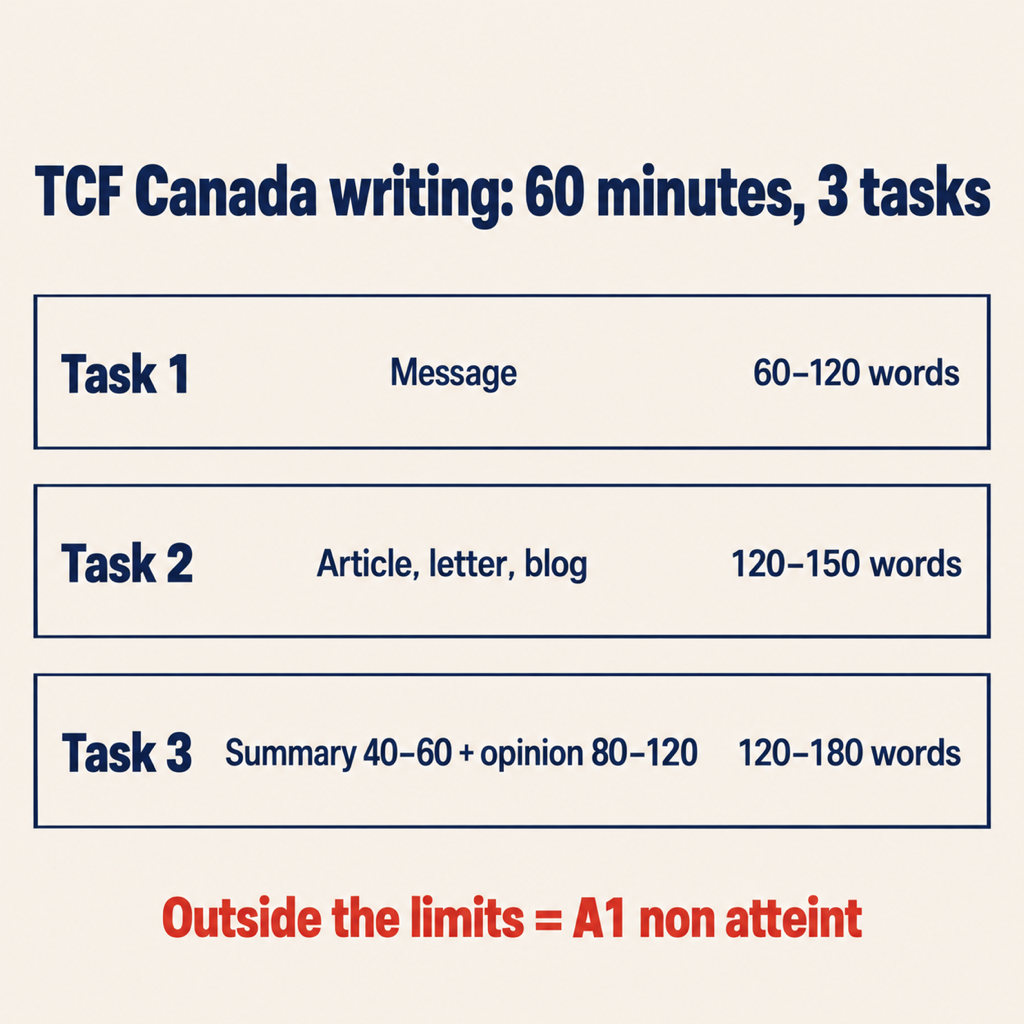
The TCF Canada writing format (expression écrite) is one 60-minute test with three tasks: Task 1 is a 60–120 word message to one person, Task 2 is a 120–150 word article, letter or note that tells an experience and comments on it, and Task 3 is 120–180 words in two parts, a 40–60 word summary of two short documents and an 80–120 word opinion. The whole paper gets one mark out of 20, which IRCC converts to an NCLC level: 10/20 is NCLC 7. One rule matters more than any tip: a task written outside its word limits is classed « A1 non atteint » by France Éducation international (FEI), the body that runs the test.
Every number below comes from FEI's TCF Canada page and demo paper, or from IRCC's Express Entry language test page.
TCF Canada writing tasks at a glance
Writing is one of four required tests in the 2 h 47 TCF Canada, next to listening (39 questions, 35 min), reading (39 questions, 60 min) and speaking (12 min). You get no dictionary and no grammar book. The three writing tasks rise in difficulty:
- Task 1, 60–120 words. A message to a named recipient that describes, narrates and/or explains. For example, an email to a friend or a lost-luggage form.
- Task 2, 120–150 words. An article, letter or note for several readers. You report an experience or tell a story, then add comments, opinions or arguments toward a goal: to complain, to persuade, to make amends.
- Task 3, 120–180 words in two parts. You get two short documents (about 90 words each) that take opposite sides on a social question. Part 1 (40–60 words): restate both views in your own words. Part 2 (80–120 words): give and defend your own position.
TCF Canada writing word limit: the rule that fails people
Many prep pages say short or long texts are merely "penalised", some even quoting a 10 or 20 percent tolerance. FEI says something stricter. Its list of cases that lead to « A1 non atteint » includes illegible writing, a text off the topic, a task not done, and a task that does not respect the minimum or maximum word count. A strong 190-word Task 3 is not a good Task 3 with a deduction; it is a fail on that task.
Count the way FEI counts. Its demo paper defines a word as any group of characters between two spaces. "Un bon sujet" is 3 words. "C'est-à-dire" is 1 word, because it contains no space. So elisions and hyphenated forms count once, and you cannot pad or trim by splitting them. In Task 3, aim for each part's own range too: a 30-word summary followed by a 150-word opinion lands at 180 overall but misses both part limits on the demo's instructions.
Safe targets: around 90–100 words for Task 1, 135–140 for Task 2, and 50 + 100 for Task 3.
TCF Canada writing time: how to split 60 minutes
FEI gives one 60-minute block for all three tasks, not a clock per task, so you manage the time yourself. Because the tasks grow in length and difficulty, a split that works for most candidates is:
- Task 1: about 15 minutes. Short and concrete; do not let it eat time.
- Task 2: about 20 minutes. Plan the story in three beats, then the comment.
- Task 3: about 25 minutes. Read both documents twice before you write the summary.
Keep two or three minutes per slot to check agreements, accents and the word count. A missing task is also « A1 non atteint », so never polish Task 2 at the cost of Task 3.
TCF Canada writing criteria: what each task is judged on
FEI groups its marking criteria into three families:
- Linguistic: range of vocabulary, grammatical accuracy, spelling, and how developed your sentences are.
- Pragmatic: coherence and cohesion (how ideas link), and how far you develop the topic.
- Sociolinguistic: whether the text fits the situation, the reader and the register.
On top of that, each task tests specific skills. Task 1 checks that you give a clear message and the information asked for, in a register that suits the reader (tu for a friend, vous for a landlord). Task 2 checks narration and description plus a supported opinion, with ideas linked in order. Task 3 is the reformulation test: Part 1 rewards restating both views in your own words, not copying sentences from the documents; Part 2 rewards a clear position with arguments and a comparison of the two sides.
Every script is marked twice, blind. On the computer version, FEI says the first marking may be done with FIDELIA, its automated marking aid, while the second marking stays human.
TCF Canada writing score: how /20 maps to NCLC
You receive a single mark out of 20 for writing, which FEI converts to a CEFR level: A2 is 2–5, B1 is 6–9, B2 is 10–13, C1 is 14–17 and C2 is 18–20. (Some prep sites print different bands, such as B2 at 10–12; FEI's own level grid says 10–13.) For immigration, IRCC uses its own table for TCF Canada writing:
- NCLC 10 and above: 16–20
- NCLC 9: 14–15
- NCLC 8: 12–13
- NCLC 7: 10–11
- NCLC 6: 7–9
- NCLC 5: 6
- NCLC 4: 4–5
That is why 10/20 is the number everyone targets. NCLC 7 in all four French skills is the threshold for Express Entry's French-language category, and it adds 25 CRS points (with English at CLB 4 or lower, or no English test) or 50 points (with CLB 5 or higher in all four English skills), per IRCC's CRS criteria. IRCC looks at each skill separately, so a weak writing mark caps the whole profile. We break down the four targets in how to get NCLC 7 in French.
TCF Canada writing on computer: keyboard and accents
FEI now offers every TCF test except speaking on computer; speaking is always face to face. Where writing is on screen, check the keyboard with your centre. Alliance Française Toronto, for example, states that it provides a standard US QWERTY keyboard, and that the test software has a virtual keyboard for accented letters. If you normally type on AZERTY, practise on QWERTY with an on-screen picker for é, è, à, ç and ê: clicking accents costs time, and missing ones cost spelling marks.
One more 2026 change: FEI has suspended re-marking of writing and speaking for sessions from 1 September 2026 until autumn 2027. Whatever mark you get stands, so the first attempt has to be clean. If you are still planning your timeline, see how long it takes to prepare for TCF Canada.
How to practise the exact format
Three habits move the mark fastest: write under the 60-minute clock with a counter that flags out-of-range tasks, read a model answer one level above yours, and get each error explained.
Objectif 7, our independent TCF Canada writing coach, is built around exactly that. Free: 36 original practice topics, each with a B2 model answer, a timed simulator with a strict word counter, an NCLC score calculator and guides for each task. The paid part is AI correction: a mark out of 20 on five criteria, an estimated NCLC level, every error explained in English or French, and your text rewritten one band higher. It is a one-time 30-day pass ($19) or 90-day pass ($39), not a subscription. Its marks are estimates, not official results, and its topics are written from scratch, not real exam questions.
Common questions
How many words is TCF Canada writing?
Between 300 and 450 words across the three tasks: Task 1 is 60–120, Task 2 is 120–150 and Task 3 is 120–180 (40–60 for the summary, 80–120 for your opinion).
What happens if I write more than 180 words in Task 3?
FEI lists a task outside its minimum or maximum word count among the cases classed « A1 non atteint ». Stay inside every range.
What writing score do I need for NCLC 7?
10 or 11 out of 20 is NCLC 7 on IRCC's table. 12–13 is NCLC 8 and 14–15 is NCLC 9.
Is TCF Canada writing on paper or computer?
It depends on the centre; FEI offers writing on computer, and many centres now use it. Ask yours which keyboard it provides.
Is the TCF Canada writing format the same as the TEF Canada?
No. TEF Canada writing has two sections with a minimum but no maximum word count. We compare both in TEF Canada vs TCF Canada: which is easier.
TCF and TCF Canada are trademarks of France Éducation international, used here only to describe the exam. Objectif 7 and RiekApps are independent and not affiliated with or endorsed by France Éducation international.