TEF Canada vs TCF Canada: Which Is Easier?
Neither is easier overall. A module-by-module comparison of TEF and TCF Canada: questions, timings, scores, NCLC 7 cut-offs, fees and retakes.
Neither TEF Canada nor TCF Canada is objectively easier. IRCC accepts both for Express Entry and converts each to the same NCLC scale, so the test that is easier is the one whose format suits you. Listening and reading are close (39 vs 40 questions); writing and speaking are where they differ. The TCF gives you three short writing tasks with strict word limits, marked out of 20. The TEF gives you two longer pieces with only a minimum word count, scored out of 450. Short, controlled writers usually do better on the TCF. People who can argue at length usually do better on the TEF.
Formats below come from France Éducation international (TCF) and Le français des affaires, CCI Paris Île-de-France (TEF); score tables from IRCC's language test page.
TEF vs TCF exam format at a glance
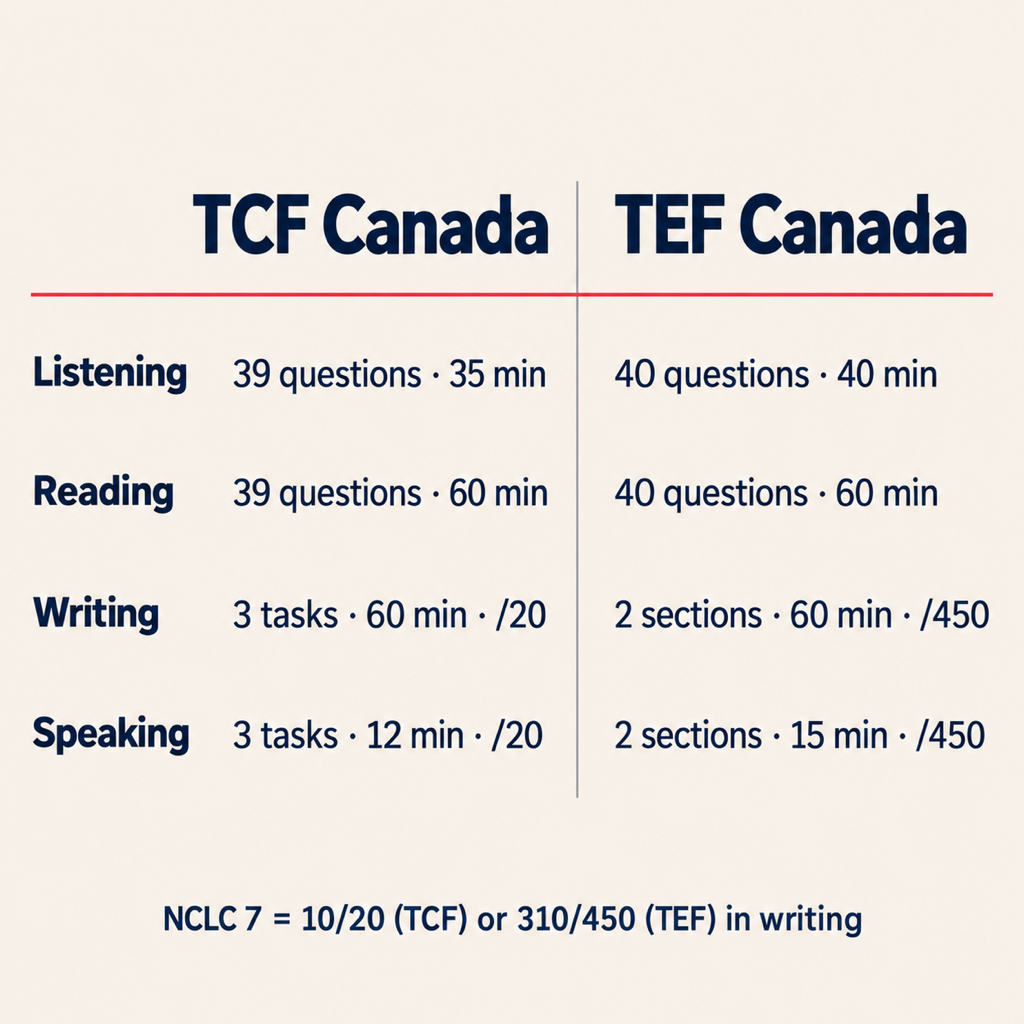
- Total time: TCF Canada takes 2 h 47. The TEF Canada modules add up to 2 h 55, and all four must be taken on the same day for IRCC to recognise the certificate.
- Score scales: On the TCF, listening and reading are scored 100–699, and writing and speaking are marked out of 20. On the TEF, IRCC only uses the certificate's "Équivalence ancien score" column: listening /360, reading /300, writing /450, speaking /450. Don't enter the "Score / 699" column. IRCC says it is not compatible with its system.
TEF vs TCF listening
- TCF Canada: 39 multiple-choice questions in 35 minutes, four options each. Each recording plays once. The questions get harder as you go, from A1 picture matching up to C2 radio talks, and some use Canadian accents.
- TEF Canada: 40 questions in 40 minutes. Audio starts automatically, plays once and you can't go back.
The TEF gives you about a minute per question, the TCF slightly less. Some prep sites report a 2025 change to TEF listening (three options on street interviews, some audio played twice). Le français des affaires hasn't confirmed it on its own pages, so don't count on it.
TEF vs TCF reading
- TCF Canada: 39 questions in 60 minutes. From short notes and ads up to long abstract or literary texts.
- TEF Canada: 40 questions in 60 minutes. Everyday, administrative and work documents, charts, then press articles.
Many comparison pages still say the TEF has 50 reading questions; that format ended on 11 December 2023, when reading and listening both moved to 40 items with the same timings. Reading is effectively a tie: about 1.5 minutes per question on both. Wrong answers cost nothing on either, so never leave a blank.
TEF Canada writing format vs TCF writing
This is the module where the choice matters most.
- TCF Canada (3 tasks, 60 min, marked /20): Task 1 is a 60–120-word message to one named person. Task 2 is a 120–150-word article or letter that tells an experience and comments on it. Task 3 is 120–180 words: summarise two short documents with opposing views (40–60 words), then give your own position (80–120 words). If any task falls outside its word range, is off-topic or is missing, the result can be "A1 non atteint".
- TEF Canada (2 sections, 60 min): Section A (25 min, at least 80 words) asks you to continue a news story from its opening lines. Section B (35 min, at least 200 words) is a letter to a newspaper reacting to a statement, with at least three arguments. There is no maximum word count.
The TCF rewards precision under a ceiling: three registers and three word limits in an hour. The TEF rewards stamina: a structured 200-word letter in 35 minutes. If you over-write, the TCF's limits are a risk; if you run dry after 120 words, TEF Section B will hurt. Our TCF Canada writing format guide goes through each task in detail.
TEF vs TCF speaking
- TCF Canada (3 tasks, 12 min including 2 min prep, /20): a 2-minute guided interview about yourself; a 5 min 30 role play (2 min prep) where you ask questions to get information; then 4 min 30 giving your opinion on a question, with no preparation.
- TEF Canada (2 sections, 15 min): Section A (5 min) is a formal phone call about an ad where you ask about ten questions. Section B (10 min) is informal: you present an ad to a "friend" (the examiner) and convince them while they push back.
The TEF puts more weight on persuasion and objections; the TCF ends with an unprepared opinion task. Different reflexes, not different difficulty.
How is TEF Canada graded vs TCF: the NCLC 7 cut-offs
IRCC converts both tests to NCLC per skill. NCLC 7 in all four skills is the cut-off for the Express Entry French-language proficiency category. It also earns 25 extra CRS points, or 50 if you also have CLB 5+ in all four English skills. Minimums for NCLC 7:
- Listening: TCF 458/699 · TEF 249/360
- Reading: TCF 453/699 · TEF 207/300
- Writing: TCF 10/20 · TEF 310/450
- Speaking: TCF 10/20 · TEF 310/450
Don't compare these as percentages: each scale is calibrated to its own test (10/20 on the TCF is B2 on France Éducation international's grid). For NCLC 9 you need 14/20 on TCF writing or 371/450 on TEF writing. To convert your own scores, use the free NCLC score calculator, which handles both tests. For a full plan, read how to get NCLC 7 in French.
TEF vs TCF cost, results and retakes
- Fees: Each centre sets its own price. For example, Alliance Française Toronto charges CAD 390 for the TCF Canada, and Alliance Française Ottawa charges CAD 390 for the four TEF Canada tests (CAD 97.50 each). Check your local centre, since prices vary.
- Results: TCF results arrive within 15 working days of France Éducation international receiving the session material. For the TEF, ask your centre; no fixed delay is published.
- Retakes: Both tests require a 20-day gap before you retake. Some TEF centres (AF Ottawa, for example) require 30 days.
- Re-marking: France Éducation international has suspended re-marking of TCF writing and speaking for sessions from 1 September 2026 until autumn 2027. The TEF allows an appeal within 30 days, but only for documented anomalies.
- Validity: 2 years for both.
- Format: Since 2026, every TCF module except speaking can be taken on computer. Speaking is always face to face.
Which is better, TEF or TCF, for Express Entry?
For IRCC, neither. Both count the same. TCF Canada is the bigger test by volume: France Éducation international reported 124,667 TCF Canada registrations in 2025. Le français des affaires reported 111,385 TEF candidates in 2024 across all versions, with TEF Canada at 44%. Often the decider is simply the earliest date at a centre near you.
Choose TCF Canada if:
- you write short, tidy texts and can stay inside a word range;
- you like tests that start easy and get harder gradually;
- you want a shorter speaking test (12 minutes) with a familiar interview opener;
- you'd rather sit listening, reading and writing on a computer.
Choose TEF Canada if:
- you can write a 200-word argued letter, and word ceilings would only get in your way;
- you're comfortable persuading and handling objections out loud;
- you want a little more time per listening question;
- you want the option to appeal a documented anomaly while TCF re-marking is suspended.
If you choose the TCF, practise writing under exam conditions. Objectif 7, our independent TCF Canada writing coach, has a free timed simulator with a strict word counter, 36 original topics with B2 model answers, and task guides. AI corrections are paid: each one gives a /20 mark across five criteria, an NCLC level, an explanation of every error in English or French, and a rewrite one band higher. They come as a one-time 30-day ($19) or 90-day ($39) pass, with no subscription. It covers TCF writing only for now. Objectif 7 isn't affiliated with either test body. TCF and TCF Canada are trademarks of France Éducation international, and TEF and TEF Canada are trademarks of CCI Paris Île-de-France.
Common questions
Is TEF Canada easier than TCF Canada?
Not overall. Listening and reading are near-identical in size; the TEF's writing has no ceiling but needs a 200-word argued letter, while the TCF's is shorter but strict on word counts.
What score do I need for NCLC 7 on TCF vs TEF?
On the TCF: 10/20 in writing and speaking, 458 in listening and 453 in reading. On the TEF (ancien score): 310/450 in writing and speaking, 249/360 in listening and 207/300 in reading.
Can I take both tests?
Yes. They are separate tests from separate bodies, and IRCC accepts either one for Express Entry. If one format doesn't suit you, you can sit the other.
Which TEF score goes in my Express Entry profile?
Only the "Équivalence ancien score" column. IRCC says the "Score / 699" column is not compatible with its system.
From the studio
Previous Article
How to Get NCLC 7 in French
Next Article
How Long Does It Take to Prepare for TCF Canada?