How to Get NCLC 7 in French
The exact TCF Canada and TEF Canada scores for NCLC 7 in each skill, what it is worth in Express Entry, and a six-week plan built around writing.
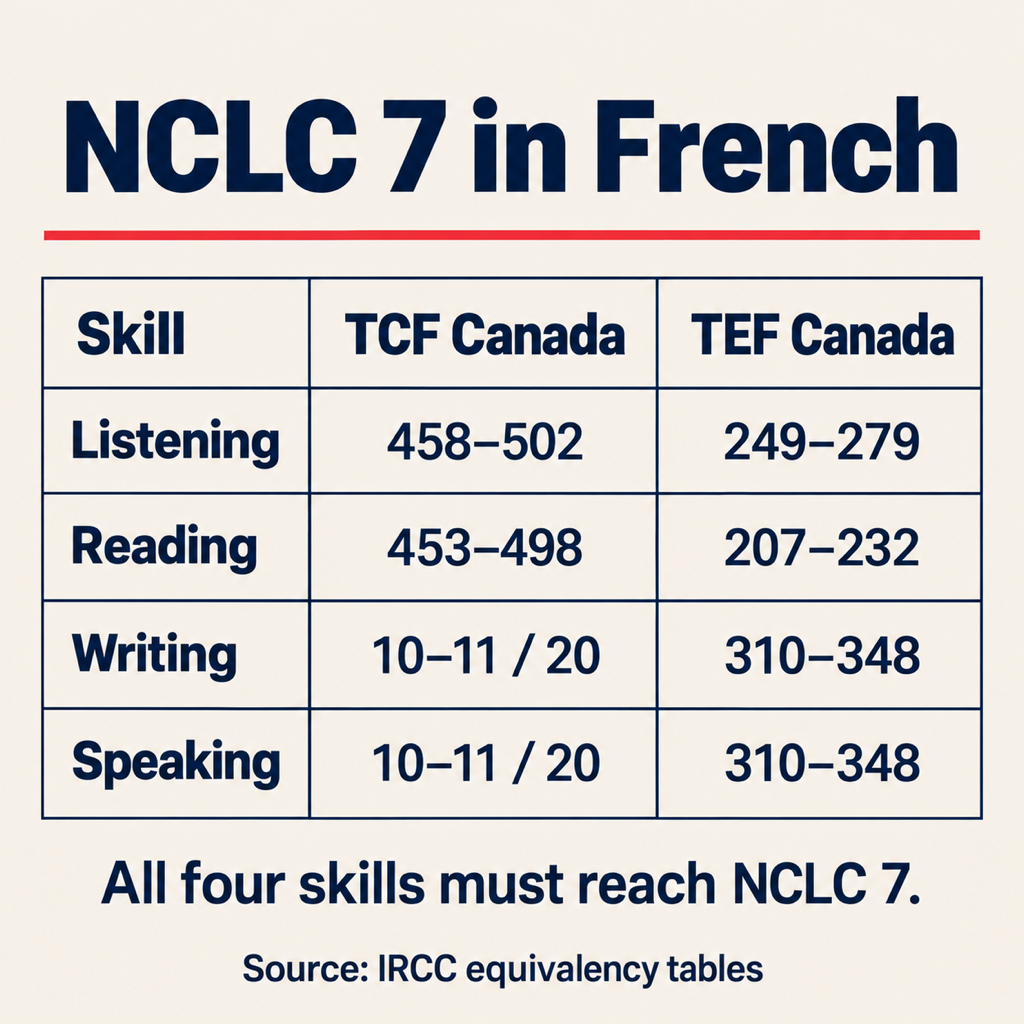
To get NCLC 7 in French, you need to reach level 7 in all four skills on TCF Canada or TEF Canada. On the TCF Canada that means at least 458 in listening, 453 in reading and 10/20 in both writing and speaking. On the TEF Canada it means at least 249 in listening, 207 in reading and 310 in both writing and speaking (old-scale scores). IRCC counts your weakest skill, so one skill at NCLC 6 means you are not NCLC 7. The quickest way there is to find your weakest skill early. For most candidates that is writing, so practise it under real exam rules until you score 10/20 every time, not just on a good day.
What NCLC 7 means: is it B1 or B2?
NCLC (Niveaux de compétence linguistique canadiens) is the French side of the Canadian Language Benchmarks, so NCLC 7 is the French counterpart of CLB 7. On the European CEFR scale, NCLC 7 sits at the low end of B2. France Éducation international, which runs the TCF, puts B2 at 400–499 for listening and reading and 10–13/20 for writing and speaking. The NCLC 7 ranges (458–502, 453–498 and 10–11/20) fall inside that B2 band. Strong B1 is not enough: a B1 writing mark (6–9/20) only gets you to NCLC 5 or 6.
Why NCLC 7 in French matters for Express Entry
NCLC 7 is where French starts to change your outcome in Express Entry, in two ways:
- The French-language proficiency category. IRCC's category-based selection page requires a minimum of NCLC 7 in all four language abilities.
- Extra CRS points. According to IRCC's CRS criteria, NCLC 7 or higher in all four French skills adds 25 points if your English is CLB 4 or lower, or 50 points if you also have CLB 5 or higher in all four English skills.
The category is the bigger prize. In IRCC's rounds of invitations, the French-language draw on 19 August 2026 invited 5,000 candidates with a lowest score of 382. The Canadian Experience Class draw on 29 September 2026 needed 518.
NCLC 7 French score: TCF Canada
From IRCC's language test equivalency tables:
- Listening (compréhension orale): 458–502 out of 699. NCLC 8 starts at 503.
- Reading (compréhension écrite): 453–498 out of 699. NCLC 8 starts at 499.
- Writing (expression écrite): 10–11 out of 20. NCLC 8 is 12–13.
- Speaking (expression orale): 10–11 out of 20. NCLC 8 is 12–13.
The margin is thinnest in writing and speaking: 9/20 is NCLC 6 and 10/20 is NCLC 7, so a single mark decides it. You can enter your own results into the TCF Canada score chart and NCLC calculator, and it shows which skill is holding you back.
NCLC 7 French score: TEF Canada
For the TEF Canada, IRCC only accepts the "Équivalence ancien score" column on your certificate, not the score out of 699. The NCLC 7 ranges are:
- Listening: 249–279 out of 360.
- Reading: 207–232 out of 300.
- Writing: 310–348 out of 450.
- Speaking: 310–348 out of 450.
The two tests set very different writing and speaking tasks. If you have not chosen yet, compare them in TEF Canada vs TCF Canada: which is easier.
Is NCLC 7 French equivalent to IELTS 6?
In CLB terms, yes. NCLC 7 is the French version of CLB 7. On IRCC's tables, CLB 7 in English is IELTS General Training 6.0 in each band (or CELPIP 7). IRCC scores the two languages separately: NCLC 7 in French is what unlocks the bonus points and the French draws.
Every skill must reach NCLC 7
A profile with 520 in listening, 510 in reading, 12/20 in speaking and 9/20 in writing is NCLC 6 for the category and gets no French bonus. Three strong skills cannot make up for a weak one, so start with a full diagnostic and spend your time on the lowest skill.
Why writing is usually the weakest skill
On the TCF Canada, writing takes 60 minutes across three tasks, each with a strict word range (the full breakdown is in TCF Canada writing format):
- Task 1, 60–120 words: a message to one named person that describes, narrates or explains.
- Task 2, 120–150 words: an article, letter or note to several readers, telling an experience and commenting on it.
- Task 3, 120–180 words: sum up two opposing documents in 40–60 words, then give and defend your own view in 80–120.
Three things make writing the usual bottleneck. First, France Éducation international marks a task as "A1 non atteint" if it falls outside its word range, is off-topic or is left unfinished. A good text with too many words can still fail. Second, two examiners mark each paper blind, scoring vocabulary range, grammar, spelling, coherence and how well the text fits the situation. Small errors that a listener would ignore cost marks on paper. Third, from 1 September 2026 until autumn 2027, FEI has suspended re-marking of writing and speaking. If you miss by a mark, you will have to retake the test.
A six-week plan to reach NCLC 7
This plan assumes you are around NCLC 5–6 (solid B1) and the TCF Canada is booked. If you are starting from further back, see how long it takes to prepare for TCF Canada. Every day, also do 30 minutes of listening (Radio-Canada, RFI) and 20 minutes of reading news or opinion pieces, and practise one speaking task out loud three times a week.
- Week 1: baseline. Sit a full 60-minute writing paper under exam conditions and a free listening and reading mock (TV5Monde has one). Get the writing marked and record your score for each skill. The lowest one sets your priority.
- Week 2: Task 1. Write four messages, giving yourself about 15 minutes each. Check that you answer every point in the prompt, use the right register (tu or vous) and stay within 60–120 words.
- Week 3: Task 2. Write three texts of about 20 minutes each. Practise switching between passé composé and imparfait in the story, then add a clear opinion with two reasons and connectors (d'abord, en revanche, c'est pourquoi).
- Week 4: Task 3. Write three texts of about 25 minutes each. Restate both documents in your own words without copying their phrases, then argue your position with an example.
- Week 5: your error log. List the errors that repeat across your corrected texts: agreements, accents, tenses, prepositions. Rewrite your two weakest texts one band higher, and do not write anything new until the same errors stop appearing.
- Week 6: full mocks. Do two complete 60-minute papers, counting words the way the exam does: a word is anything between two spaces, so c'est-à-dire counts as one. Aim for 11–12/20, so a bad day still lands at 10.
To practise writing under these rules, Objectif 7 has 36 original TCF Canada writing topics, each with a B2 model answer. It also has a timed simulator with the strict word counter and guides for each task, such as Task 3. All of that is free. AI corrections need a one-time pass ($19 for 30 days or $39 for 90 days, no subscription). Each correction gives an estimated mark out of 20 on five criteria, the matching NCLC level, every error explained in English or French, and your text rewritten one band higher. The marks are estimates; how scoring works explains the method. Objectif 7 is independent. TCF and TCF Canada are trademarks of France Éducation international, and the topics are original, not real exam questions.
Booking, retakes and validity
You can retake the TCF Canada as many times as you like, with at least 20 days between sittings. The TEF also requires a 20-day gap, and some centres ask for 30. IRCC requires results to be less than two years old both when you create your Express Entry profile and when you submit your permanent residence application. Book the test once your mock writing marks are consistently at 11 or above.
Common questions
Is NCLC 7 B1 or B2?
B2. The TCF ranges for NCLC 7 fall inside FEI's B2 band (400–499, 10–13/20). A B1 writing mark of 6–9/20 gives NCLC 5 or 6.
What TCF writing score do I need for NCLC 7?
10 or 11 out of 20. 9/20 is NCLC 6, and 12/20 is NCLC 8.
Can I get the French CRS points with one skill at NCLC 6?
No. Both the 25/50 bonus points and the French-language category require NCLC 7 in all four skills.
Can I ask for my TCF writing to be re-marked?
Not for sessions between 1 September 2026 and autumn 2027. FEI has suspended re-marking of writing and speaking for that period, so plan to pass with a margin.