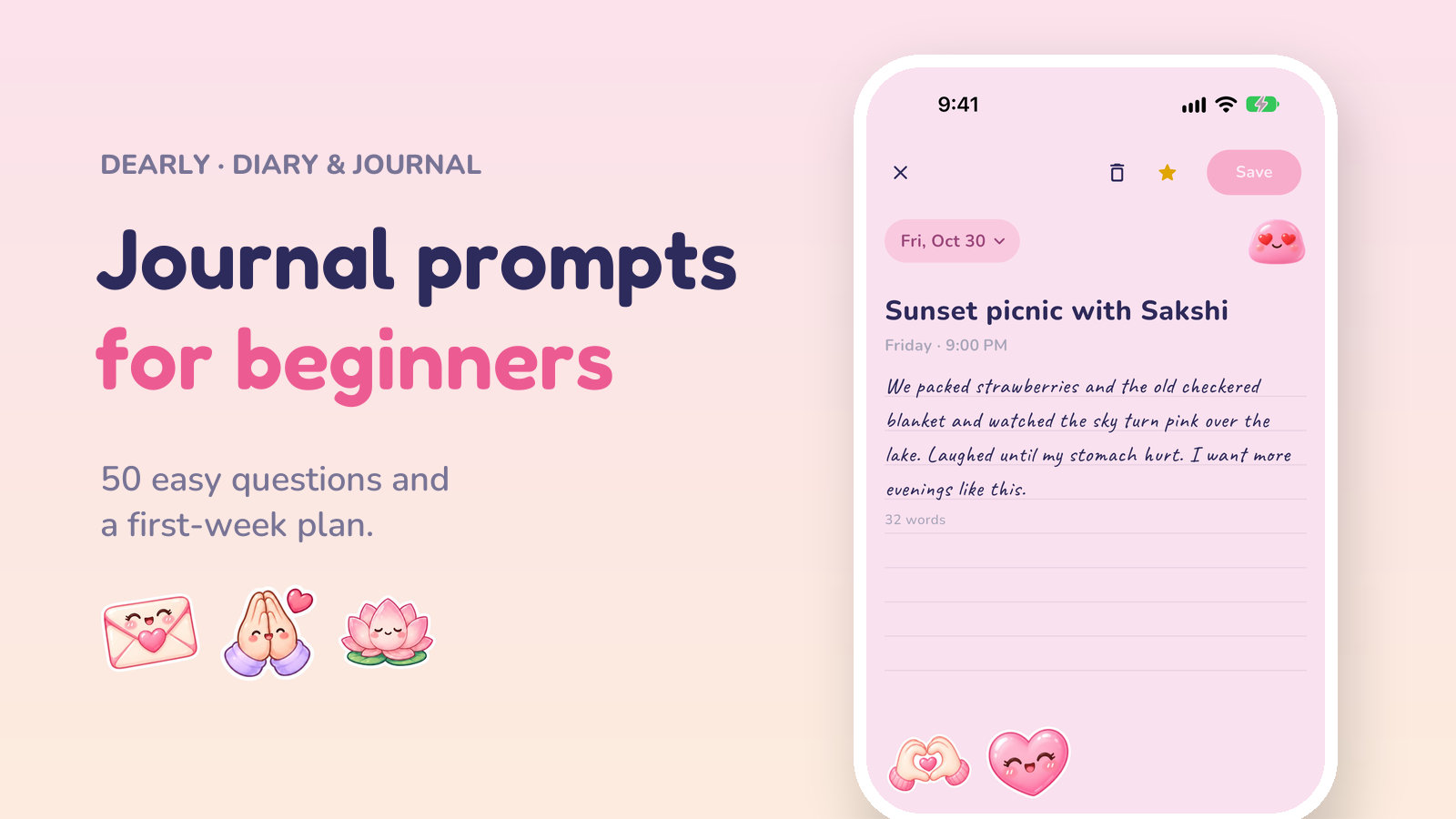
Journal Prompts for Beginners: 50 Easy Questions and a First-Week Plan
Journal prompts for beginners: 50 short, easy questions (one-line, self-discovery, gratitude, stress, goals) plus a 7-day starter plan and how to use them.
The best journal prompts for beginners are short, specific and answerable in five minutes, like “What took more energy today than it should have?” or “What is one thing I’d do again from this week?”. Pick one, set a timer for five minutes, and write until it rings. That is the whole method. Below are 50 easy prompts sorted by what you want from journaling, a seven-day plan for your first week, and the mistakes that make beginners quit.
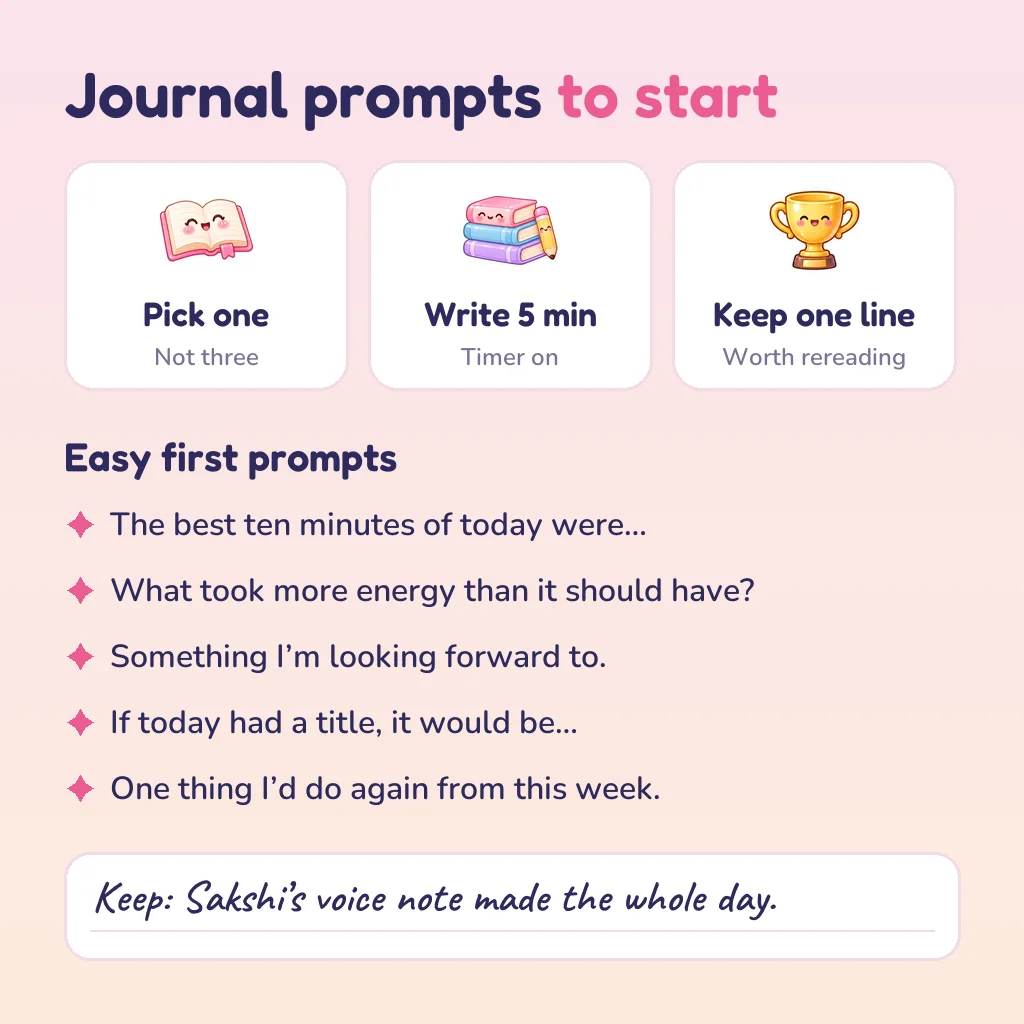
How to use journal prompts (the 5-minute rule)
- Choose one prompt, not three. A beginner’s journal fails from too much, not too little.
- Set a five-minute timer and keep writing until it rings, even if you write “I don’t know what to say” twice.
- Don’t reread or fix anything. Spelling, grammar and neat handwriting are for later, or never.
- Finish with one line to keep: the sentence you’d want to read again in a year.
- Same time every day. Tie it to something you already do: coffee, the bus, getting into bed.
One-line journal prompts for beginners
For days when five minutes is too much. Answer in a single sentence and you have journaled.
- Today felt like a ___ day because ___.
- The best ten minutes of today were…
- Right now my body feels…
- One thing I want to stop doing this week.
- A sound, smell or taste from today.
- Something I’m looking forward to, however small.
- One word for my mood, and one for the weather.
- What took more energy today than it should have?
- A message I was happy to get.
- If today had a title, it would be…
Your first week: one prompt a day
If you want a plan, start here. Each day is a little deeper than the one before, so the habit builds before the questions get personal.
- Day 1: Why do I want to start journaling, and what would make it worth it?
- Day 2: Describe an ordinary morning in my life right now, in detail.
- Day 3: What am I carrying around in my head that I haven’t said out loud?
- Day 4: Three people who matter to me, and one thing I appreciate about each.
- Day 5: What does a good day look like for me, start to finish?
- Day 6: What is one thing I keep putting off, and what is the first tiny step?
- Day 7: Read back the week. What surprised me? What do I want more of?
After day seven, mix the lists below, or use the ideas in what to write in a diary for everyday entries.
Self-discovery journal prompts
- What do people usually come to me for?
- When do I lose track of time?
- What did I love doing at ten years old that I stopped?
- Which compliment do I secretly agree with?
- What am I pretending not to know?
- Which values would I refuse to trade for money?
- What would I do differently if no one I know would ever find out?
- What does “enough” look like for me: money, work, friends?
Gratitude journal prompts for beginners
Gratitude works best when it is specific. “My family” is a category; “Mum sending a photo of the dog” is a moment.
- Something today that I would miss if it were gone tomorrow.
- A person who made today easier, even without knowing.
- Something in my room I’m glad I own.
- A part of my body that did its job well today.
- A problem I had a year ago that I don’t have now.
- Something free that I enjoyed this week.
Journal prompts for stress and anxiety
Writing a worry down makes it smaller and more concrete. These keep it practical.
- What exactly am I worried about? Write it as one sentence.
- What is in my control here, and what is not?
- What would I tell a friend who had this exact worry?
- What is the most likely way this actually goes?
- What is one thing I can do in the next hour that would help a bit?
- What helped the last time I felt like this?
A journal is support, not treatment. If anxiety or low mood is heavy or doesn’t lift, talk to someone you trust or a doctor. Our guide on what to do when you feel lonely lists helplines.
Goal and future journal prompts
- Where do I want to be this time next year, in one paragraph?
- What is one habit that would make the biggest difference if I kept it for 90 days?
- What am I saying yes to that I should say no to?
- What would future me thank me for doing this week?
- What skill do I want people to know me for?
- What did I finish this month that I’m proud of?
Common beginner mistakes
- Writing only on bad days. Rereading later gives you a darker picture of your life than the real one. A line on good days matters.
- Buying the perfect notebook first. Start on anything; earn the nice one.
- Long entries in week one. Two minutes every day beats an hour once.
- Giving up after a missed day. Skip one, write the next. Nobody grades a journal.
Prompts on your phone: Dearly
Dearly (“Diary with Lock: Dearly” on Google Play) is our journal and diary app, built so the page is never blank. It is on Google Play now.
- A new prompt on the empty page every day, such as “What made you smile today?” or “What drained you, and what filled you up?”, 16 in rotation, and you can tap for another one.
- A mood with each entry, eight to choose from, which build a mood calendar and stats, so day 7 of your first week is easy to read back.
- Photos, voice notes and 50+ hand-drawn stickers on 20+ papers in 16 themes, with 25+ fonts.
- A PIN plus fingerprint or face lock, no account and no ads: everything stays on your phone.
Writing, the lock, stickers, voice notes and stats are free with no time limit. Dearly Plus adds every theme, paper, font and mood face plus PDF export: $19.99 a year with a 7-day free trial, $2.99 a month, or $29.99 once, in the US. New to it? Start with how to start a diary.
Common questions
What should a beginner write in a journal?
Answer one short prompt for five minutes, then write one line worth keeping. “What took more energy today than it should have?” or “The best ten minutes of today were…” are good first prompts.
How do I start journaling if I don’t know what to write?
Use a prompt and a timer. Five minutes of writing, even “I don’t know what to say”, is a successful entry. The first week plan above gives you one question per day.
How long should a journal entry be for a beginner?
One sentence to one page. Five minutes is enough. Short entries you write daily beat long ones you write once.
Is it better to journal in the morning or at night?
Whichever you will keep. Morning entries help you plan; night entries help you process the day and wind down. Tie it to a habit you already have.
What is a good journal app with prompts for beginners?
Dearly shows a new prompt on the empty page every day and asks for your mood with each entry, with a PIN or fingerprint lock and no account. Writing and the lock are free.
What is the difference between a journal and a diary?
Mostly habit. A diary records what happened; a journal leans toward thoughts, feelings and reflection, often guided by prompts. Most people mix both.
From the studio
Previous Article
Glow Up Checklist: Daily, Weekly and One-Time (Body, Skin, Mind, Space)
Next Article
Torn Paper Effect: How to Make It on Photos and Videos