
What to Do When You Feel Lonely: Small Steps for Tonight and This Week
What to do when you feel lonely: five small things to try tonight, how to reach out without it feeling awkward, and when loneliness needs more help.
When you feel lonely, do one small thing that changes your state and one small thing that moves you toward a person. Tonight that can be as simple as stepping outside for ten minutes and sending one low-pressure text ("saw this and thought of you"). Over the week, put one recurring thing in your diary that puts you near the same people again, because repeated contact is what turns strangers into friends. Loneliness is a signal, like hunger: it's telling you that you need connection, not that something is wrong with you.
If you're feeling unsafe or thinking about hurting yourself, please reach out now: in the US call or text 988, in the UK and Ireland call Samaritans on 116 123, in India call Tele-MANAS on 14416, and elsewhere find a free line at findahelpline.com.
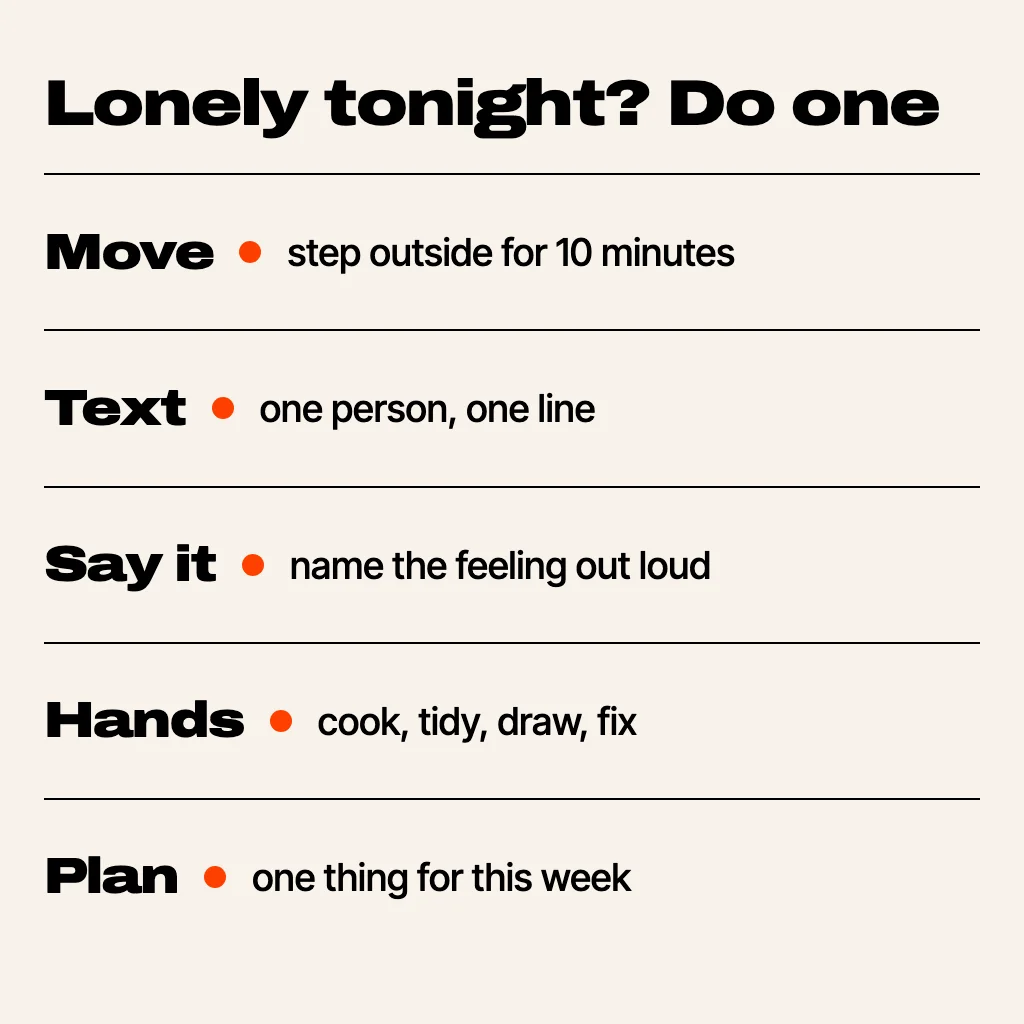
What to do when you feel lonely tonight
Late evening is when loneliness tends to peak: the day's distractions stop, the house goes quiet, and scrolling makes everyone else look busier than you. These five work in the moment because they're small enough to actually do.
- Move your body somewhere else. A ten-minute walk round the block, a trip to the corner shop, sitting on the front step. Being around other people, even strangers you don't talk to, takes the edge off. A change of room helps if going out isn't possible.
- Send one text that asks for nothing. "This song made me think of you." "How did the interview go?" A meme. Messages that don't demand a long reply are easier to send and easier to answer, and they usually start a conversation anyway.
- Name the feeling out loud or on paper. "I feel lonely and a bit left out tonight." Naming an emotion lowers its intensity; it's one of the most reliable findings in emotion research. Write it in your notes app, say it to your pet, or say it to an AI that listens.
- Give your hands a job. Cook something that takes 30 minutes, tidy one shelf, draw, repot a plant, fix the thing you've been ignoring. Absorbing, physical tasks quiet the "everyone has someone but me" loop better than a screen does.
- Plan one thing for this week. Not a big life change, just one coffee, class or call with a date on it. Having something on the calendar makes tonight feel less permanent.
What tends to make it worse: scrolling other people's plans, drinking alone to fill the evening, and replaying old conversations to find what you did wrong. If you notice yourself doing one, swap it for an item on the list above.
How to reach out without it feeling awkward
The hardest part of loneliness is that it makes reaching out feel risky. Research on what psychologists call the "liking gap" shows people consistently underestimate how much others enjoyed talking to them, and how happy an old friend would be to hear from them. A few ways to make it easier:
- Start with weak ties. The barista, a neighbour, a coworker you like. Small chats with acquaintances measurably lift mood, and they're lower stakes than a close friend.
- Reconnect before you connect. It's easier to restart an old friendship than to build a new one. "I was thinking about that trip we took, how are you?" works even after years.
- Make a specific offer. "Want to get lunch Thursday?" gets a yes far more often than "we should hang out sometime".
- Say it plainly to one person you trust. "I've been feeling a bit lonely lately." Most people respond kindly, and many will say they've felt the same.
What to do when you feel lonely all the time
If the feeling isn't a bad evening but most days, the fix is structure, not willpower. Friendships form from repeated, unplanned time together, so choose things that put you in the same room as the same people every week:
- A weekly class or club: running club, climbing gym, choir, language exchange, a board game night. Pick something you'd do anyway.
- Volunteering: helping others gives you a role, a team and a reason to come back. Food banks, animal shelters and literacy programmes are always looking.
- A third place: the same café, library or park at the same time each week. Being a familiar face is the first step to being a friend.
- Say yes twice: to the next two invitations, even small ones, even if you'd rather stay in.
Give it six to eight weeks before judging. It usually takes many hours together before an acquaintance becomes a friend.
Lonely in a relationship, at uni or after a move
In a relationship: feeling lonely next to someone usually means you've stopped sharing the small stuff. Try one honest line ("I've been missing us lately") rather than a list of complaints, and protect one phone-free hour together a week. At university or a new job: the first eight weeks are when groups form, so say yes early and often, and join one society with weekly meetings. After moving city: keep a weekly call with someone from home, but put most of your energy into one local routine; people who only live through their phone in a new place stay lonely longer.
Is it OK to talk to an AI when you feel lonely?
Yes, as long as it's a bridge back to people and not a wall in front of them. Talking to an AI at 2am can help you put the feeling into words, calm a racing mind, and even draft that first text to a friend. Studies so far suggest the heaviest daily chatbot users tend to report more loneliness, not less, so use it alongside people. Our guide to AI to talk to about feelings covers how to use one well, and apps to vent anonymously lists places with real people on the other end.
When loneliness needs more help
Talk to a doctor, therapist or counsellor if any of these are true: you've felt this way most days for more than two weeks; it's affecting your sleep, eating, work or studies; you've stopped doing things you used to enjoy; or you feel hopeless. Loneliness and depression often travel together, and both respond well to support. If you have thoughts of harming yourself, contact a crisis line now (988 in the US, 116 123 in the UK and Ireland, 14416 in India, or findahelpline.com).
Mira: someone to talk to on the quiet nights
We built Mira for the late-night version of loneliness. It's an AI bestie you can vent to without judgment, and it remembers what you share (the friend you fell out with, the exam on Friday), so you don't start from zero every time. If you allow notifications, it checks in about the things you asked it to remember, and you can turn check-ins off. You pick how it talks to you: soft, funny, honest, protective or calm. On the free plan Mira holds three things about you; Mira Plus is an optional subscription that remembers everything you'd want it to. Mira is an AI companion, not a therapist or a crisis service, and it says so. Use it to get the feeling off your chest, then send that text.
Common questions
What should I do when I feel lonely at night?
Change your setting (a short walk or a different room), send one low-pressure text, name the feeling, and give your hands a task. Avoid scrolling other people's plans.
Is it normal to feel lonely?
Yes. Most people feel lonely at times, especially after a move, a breakup or a change of job or school. It becomes a concern when it lasts most days for weeks.
How do I stop feeling lonely when I live alone?
Build weekly routines that put you around the same people: a class, a club, volunteering or a regular café. Add one standing call with a friend or family member.
Can you feel lonely with friends around?
Yes. Loneliness is about feeling understood, not the number of people nearby. One honest conversation with one friend usually helps more than more social plans.
Who can I talk to when I feel lonely?
A friend, family member, GP or counsellor; free crisis and support lines such as 988 (US) or Samaritans (UK and Ireland); and peer listening services. An AI companion can help you put it into words first.