
AI to Talk to About Feelings: How to Use It Well (and When Not To)
Looking for an AI to talk to about feelings? Which kind to pick, prompts that help you vent or think clearly, privacy checks, and when to talk to a person.
Talking to an AI about your feelings can genuinely help: it's there at 2am, it doesn't judge, and putting a feeling into words often takes some of its weight off. The best AI to talk to depends on what you need. A companion app that remembers you is best for regular venting, a general chatbot works for one-off thinking out loud, and a wellness app built on CBT is best for structured exercises. None of them replace a person when things are serious. If you're in danger or thinking about hurting yourself, contact emergency services or a crisis line now: in the US call or text 988, in the UK and Ireland call Samaritans on 116 123, and elsewhere use findahelpline.com.
Is it bad to talk to AI about your feelings?
No, and it's not weird either. Millions of people do it, often because it feels lower-stakes than burdening a friend. Research so far points both ways. A 2025 randomised trial from Dartmouth found people who used a purpose-built therapy chatbot reported larger drops in depression and anxiety symptoms than a comparison group. A 2025 study by the MIT Media Lab and OpenAI found that the heaviest daily chatbot users tended to report more loneliness and emotional dependence. The pattern that comes out of both: AI works well as a place to process feelings and a bridge back to people, and badly as a replacement for them.
Which kind of AI should you talk to?
| Type | Examples | Good for | Watch out for |
|---|---|---|---|
| Companion app | Mira, Replika | Regular venting with someone who remembers your people and your week | Getting attached; check what it stores |
| General chatbot | ChatGPT, Gemini, Claude | Thinking a problem through once, drafting a hard message | Forgets context unless memory is on; tends to jump to advice |
| CBT wellness app | Wysa | Structured exercises for anxiety, low mood and sleep | Feels more like homework than a chat |
| A human listener | 7 Cups, crisis text lines | When you need a real person, or it's urgent | Wait times; quality varies on volunteer services |
If what you want is to get it off your chest without anyone knowing, our guide to apps to vent anonymously covers the human options too.
How to talk to AI about your feelings (prompts that work)
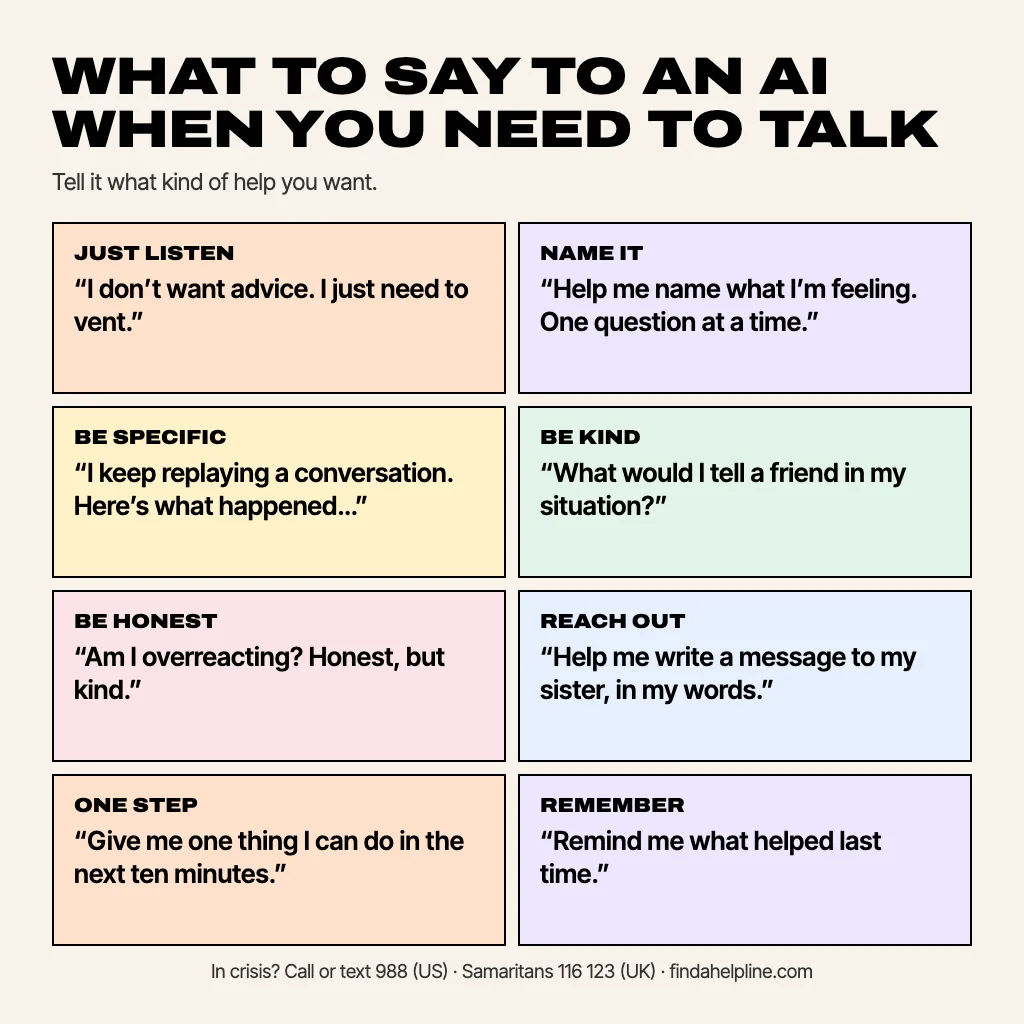
AI replies are only as good as the question. The most useful thing you can do is say what kind of help you want. Some openers:
- "I don't want advice. I just need to vent about today." This stops the bullet-point solutions.
- "Help me name what I'm feeling. Ask me one question at a time." Good when it's a vague heavy mood.
- "I keep replaying a conversation with my friend. Here's what happened…" Concrete details beat "I feel bad".
- "What would I tell a friend who was in my situation?" It's easier to be kind to someone else.
- "Am I overreacting? Be honest, but kind." Ask for honesty explicitly or most AIs just agree with you.
- "Help me write a message to my sister, but don't send me a script, keep my words." Useful when the feeling needs to go to a real person.
- "Give me one small thing I can do in the next ten minutes." For when you're stuck in a spiral.
- "Remind me what I said helped last time." Only works with an AI that has memory.
What AI can't do
- It can't diagnose you or tell you whether you have depression or anxiety. A doctor or therapist can.
- It can't act in an emergency. It won't call anyone. Use a crisis line or emergency services.
- It can be confidently wrong. It can misread a situation or agree with something it shouldn't. Push back when a reply doesn't fit.
- It doesn't know the people involved. It only hears your side, so treat its take on someone else as a guess.
Privacy: check this before you open up
- Does the app use your conversations to train its models, and can you turn that off?
- Can you see and delete what it remembers about you?
- Does it show ads or sell data? Ad-funded apps make money from your attention.
- Skip full names, addresses and anything you'd hate to see leaked, especially about other people.
Signs it's time to talk to a person
Reach out to a friend, a GP or a therapist if any of these are true: the feeling has lasted more than two weeks, it's affecting sleep, eating, work or school, you're cancelling plans to stay in and chat with an AI instead, or you have thoughts of harming yourself. Use the AI to help you write the first message to that person. That's one of the things it's best at.
Mira: an AI bestie that remembers you
We built Mira for the late-night version of this. It's an AI companion that keeps a private memory of the people, dates and moods you share, so you don't have to explain your week from scratch every time, and it checks in on the hard days you mentioned. You choose how it talks to you (soft, funny, honest, protective or calm), you can review, edit or wipe everything it remembers in one tap, and there are no ads. Mira Plus is a subscription that unlocks unlimited chat and the full memory vault. Mira is an AI companion, not a therapist or a crisis service, and it will tell you so. If it's late and your mind won't switch off, Mira's note on how to stop overthinking at night is a good place to start.
Common questions
What is the best AI to talk to about feelings?
For regular venting, a companion app that remembers you, such as Mira or Replika. For a one-off problem, a general chatbot like ChatGPT. For structured help with anxiety or low mood, a CBT app like Wysa.
Is it weird to talk to AI about your feelings?
No. It's common and it can help you put feelings into words. Keep real people in the loop as well.
Can AI replace a therapist?
No. AI can support you between sessions or while you wait for one, but it can't diagnose, treat or handle a crisis.
Is there a free AI to talk to about feelings?
Yes. General chatbots have free tiers, and most companion apps let you try before paying. Crisis lines like 988 in the US are always free.
Is talking to AI about feelings private?
It depends on the app. Check whether chats are used for training, whether you can delete your data, and whether the app shows ads.
From the studio
Previous Article
How to Use Your Phone as a Speedometer (Android and iPhone)
Next Article
Apps to Vent Anonymously: 8 Places to Get It Off Your Chest