How to Start a Diary (and Keep It Going Past Week Two)
How to start a diary: paper or app, what to put on the first page, how to start each entry, keeping it private, and the small habits that keep it going.
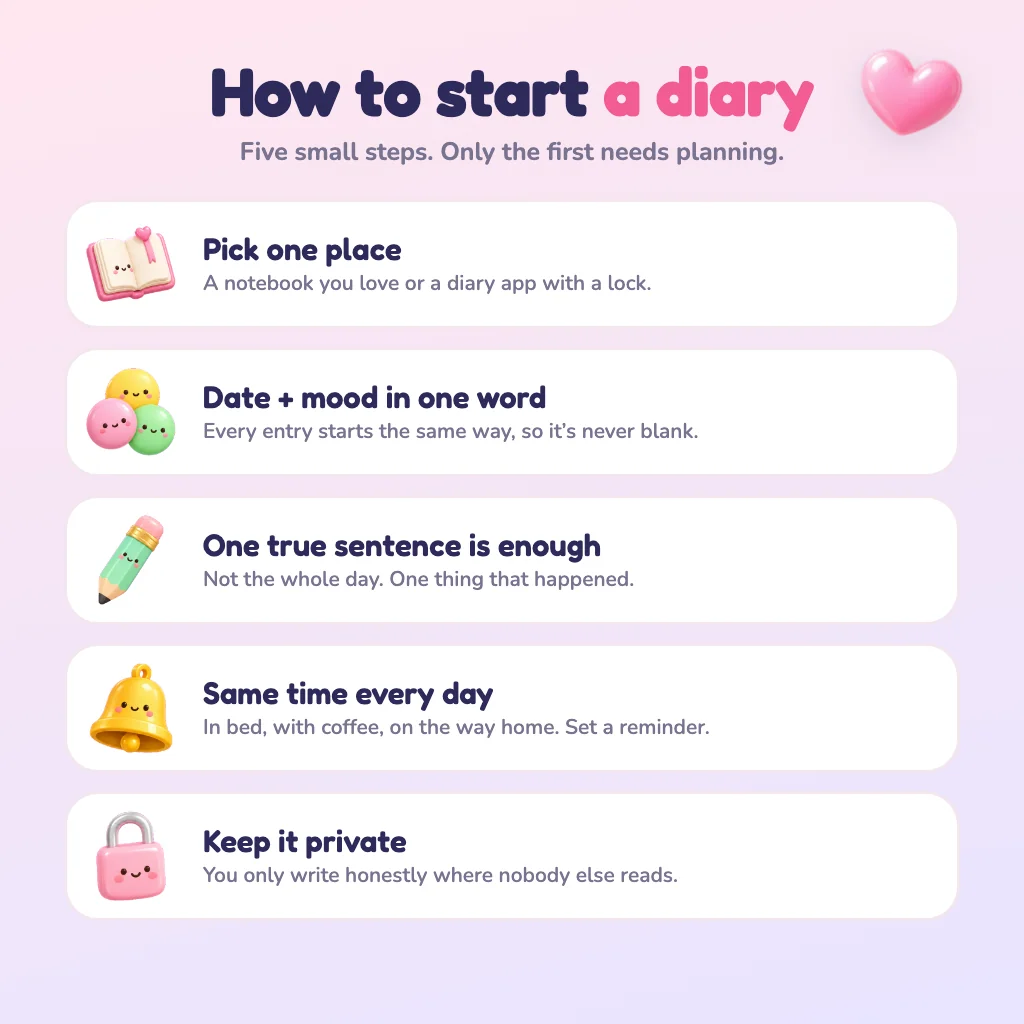
To start a diary, pick one place to write (a notebook you like or a diary app with a lock), write today’s date and one honest sentence about today, then write again tomorrow at the same time. That is the whole start. Most diaries don’t fail on page one; they fail around day ten, when the first excitement wears off and writing starts to feel like homework. So the rest of this guide is about the first page and, more importantly, about the small choices that make page twenty happen.
Paper diary or diary app?
Both work. Choose the one you will actually have with you at the moment you feel like writing.
- A paper diary is slower, which many people like: handwriting makes you choose words. It is also easy to find and read, so if privacy matters, get one with a lock or keep it somewhere only you go. Pick a size you can carry; an A5 notebook that stays at home gets written in less than a pocket one.
- A diary app is always in your pocket, can lock with your fingerprint or face, never runs out of pages, and can add photos and voice notes to a day. It can also remind you at the time you chose, which matters more than it sounds.
Whichever you pick, use one. Notes split between a notebook, a notes app and voice memos never turn into a diary you reread.
What to write on the first page of a diary
The first page feels important, so people freeze on it. Take the pressure off by giving it a job. Any of these work:
- An introduction. Your name, age, where you live, what you do all day, who matters to you right now. In five years this page will be the most interesting one.
- Why you are starting. A breakup, a new city, a new school year, wanting to remember your kids being small, or just feeling scattered. Name it.
- A snapshot of now. Your favourite song this month, what is in your bag, what you are worried about, what you are looking forward to.
- A letter to yourself to open in a year: what you hope will have changed.
If you like a decorated diary, the first page is also where a photo, a ticket stub or a few stickers go. Keep it to ten minutes. A beautiful first page you never follow up is just a pretty page.
How to start a diary entry
Every entry can start the same way, which removes the blank-page problem for good:
- The date (and the time, if you write more than once a day).
- Your mood in one word: great, okay, tired, sad, angry. Over months these words become a mood record you can actually look back on.
- One sentence about today. Not a summary; one thing. “The bus driver waited for me.” “I said no to the extra shift.”
Then keep going only if you want to. Some people start every entry with “Dear Diary,” which feels a bit old-fashioned but works: writing to someone makes it easier to be honest. If you get stuck after the first line, our list of what to write in a diary has 60 ideas grouped by mood and situation.
Diary entry for school
If you are here because a teacher asked for a diary entry, the format is stricter: the date, day and time at the top left, a salutation (“Dear Diary”), the body in the first person and past tense, about an event and how you felt about it, and your name at the end. That is a writing exercise; a personal diary has no rules.
Pick a time, not a word count
The habit that keeps diaries going is a fixed moment, not a target length. Tie writing to something you already do every day:
- In bed, before you put the phone on charge.
- With the first coffee, before you open messages.
- On the commute home, as the day closes.
Set a reminder for that moment for the first month. And set the bar low: one sentence counts as a day. On good days you will write a page anyway. On bad days the single line keeps the chain alive, and the chain is what you are building.
Keep your diary private
You will only write honestly in a diary you trust nobody else will read. That means deciding up front:
- Paper: a diary with a lock and key stops a curious sibling, not a determined one. Where you keep it matters more than the lock.
- App: use a PIN plus fingerprint or face unlock, and check where the entries are stored. A diary app that keeps everything on your phone, with no account, has nothing for anyone else to log in to.
- Shared devices: if family use your phone or tablet, the app lock is not optional.
How to keep a diary going
- Missed a day? Write today anyway. Don’t back-fill the gap or apologise to the diary. A diary with holes in it is still a diary.
- Reread one old entry a week. This is the payoff that makes writing feel worth it. Something you were sure would ruin your month is usually a footnote three weeks later.
- Use prompts on empty days. “What made you smile today?” gets more out of a dull Tuesday than “How was your day?”
- Make it nice to open. A good pen, a paper colour you like, a few stickers. It sounds trivial, but you return to things you enjoy looking at.
- Track something. A mood each day turns into a pattern after a month: which days are hard, what lifts you. Our morning routine guide uses a two-minute journal for the same reason.
Start a diary on your phone with Dearly
Dearly (“Diary with Lock: Dearly” on Google Play) is our diary app, built for exactly the habits above. It is on Google Play now; the iPhone version is in App Store review.
- Lock: a PIN plus fingerprint or face unlock, and the diary hides from the recent-apps screen while it is locked. The lock is free.
- Private by default: no account, no ads, entries stay on your phone. Move to a new phone with a backup file you control.
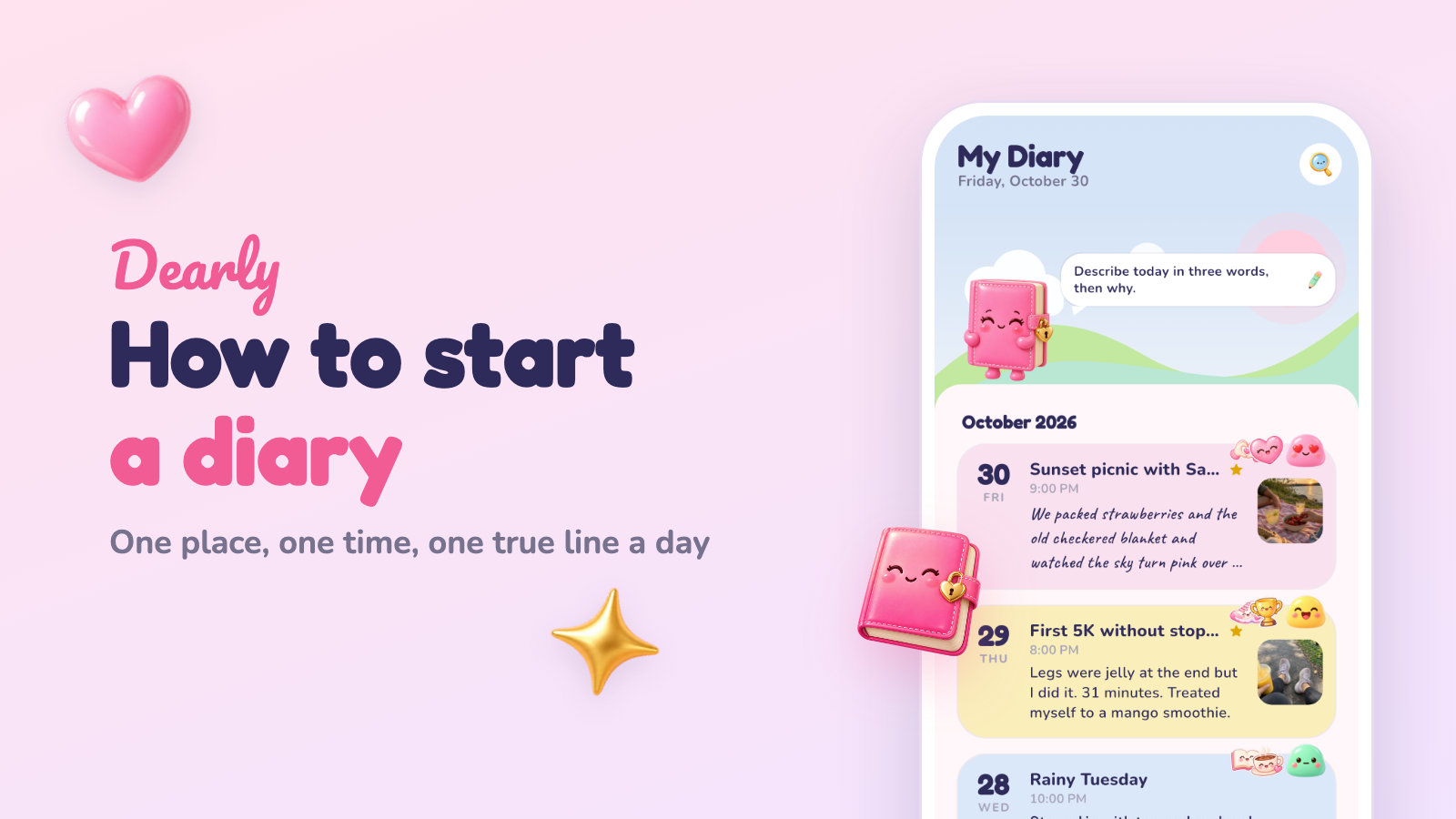
- Every entry starts with a mood (eight of them, from Great to Angry) and a prompt for the day when the page is empty.
- A daily reminder at the time you pick, plus a calendar, mood stats, streaks and small awards that make day 30 feel like something.
- Make it yours: photos, voice notes and 50+ hand-drawn stickers in any entry; 16 themes, 20+ papers and 25+ fonts.
The diary, lock, stickers, voice notes, calendar and stats are free with no time limit. Dearly Plus unlocks every theme, paper, font and mood face plus PDF export: $19.99 a year with a 7-day free trial, $2.99 a month, or $29.99 once, in the US.
Common questions
What is the difference between a diary and a journal?
A diary is usually a dated record of what happened and how you felt; a journal can also hold ideas, goals, lists and plans. In practice people use the words interchangeably, and you can mix both in one book or app.
How long should a diary entry be?
As long as you want on that day. One sentence is a complete entry. Most people who keep a diary for years write a few lines most days and a long entry when something big happens.
Should I start my diary on January 1st?
No. Waiting for a fresh year, month or Monday is the most common way never to start. Start today; the date on page one is part of the story.
Is it weird to start a diary as an adult?
Not at all. Writing about your day is one of the simplest ways to notice your own patterns and clear your head before sleep. Plenty of adults keep one; they just don’t mention it.
What is a good diary app with a lock?
Pick one with a PIN plus fingerprint or face unlock, and check where your entries are stored. Dearly (“Diary with Lock: Dearly”), our app, keeps everything on your phone with no account and a free lock. Day One is a popular choice if you want encrypted sync across several devices.
What if someone reads my diary?
Choose your privacy before you write anything you would hate to have read: a hidden notebook, or an app with a PIN and biometric lock that stores entries on your own phone.
From the studio
Previous Article
Meilleur clavier IA Android : 6 claviers comparés selon ce que vous voulez faire
Next Article
What to Write in a Diary: 60 Ideas for Every Day