
How to Stop Overthinking at Night: 9 Things to Try in Bed
How to stop overthinking at night: a 2-minute worry list, longer exhales, the cognitive shuffle, the 20-minute rule, and when racing thoughts need more help.
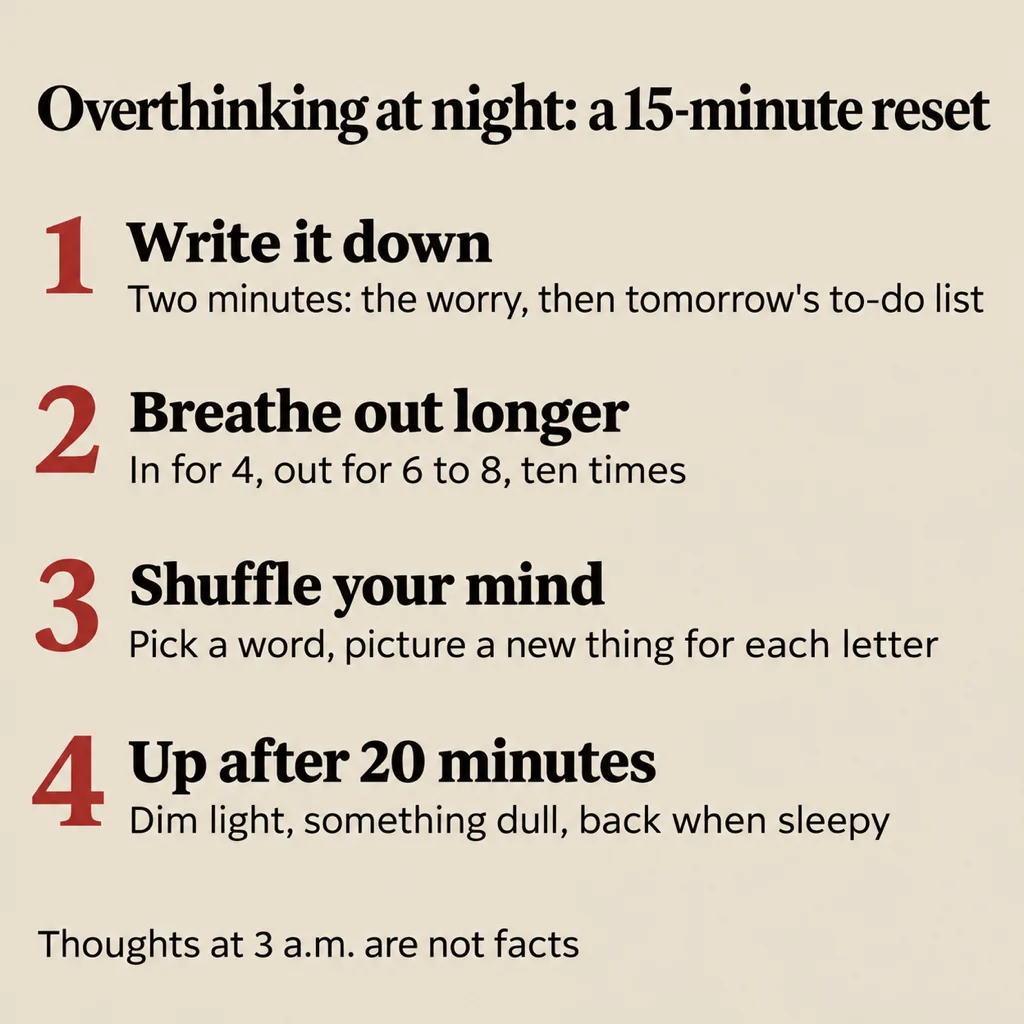
To stop overthinking at night, get the thoughts out of your head before bed and give your brain something boring to do once you're in it. Spend two minutes writing down what's bothering you and tomorrow's to-do list, breathe out longer than you breathe in, and if your mind still races, play the "cognitive shuffle": picture a random, unrelated object for each letter of a word. If you're still awake after about 20 minutes, get up, sit somewhere dim and do something dull until you feel sleepy. Below is why your mind gets loud at night and nine things that help, in the order to try them.
If your thoughts tonight are about hurting yourself or you feel unsafe, please reach out now: in the US call or text 988, in the UK and Ireland call Samaritans on 116 123, in India call Tele-MANAS on 14416, and elsewhere find a free line at findahelpline.com.
Why you overthink at night
During the day, work, people and your phone keep your attention busy. In a dark, quiet room there is nothing left to compete with the unfinished business: the message you didn't answer, the thing you said at dinner, next week's deadline. Your brain treats an open loop as something to keep rehearsing, and lying still gives it all the room it wants.
Being tired makes it worse. When you're exhausted, problems look bigger and less solvable than they will at breakfast. That's why the same worry that felt like a catastrophe at 2 a.m. often seems manageable by lunch. Remembering that is a tool in itself: thoughts at 3 a.m. are not facts.
Before bed: close the loops
1. Give worry its own time, earlier
Pick 15 minutes in the early evening, well before bed, as "worry time". Sit with a notebook and write each worry and one next step, even a tiny one ("email Sam tomorrow"). Then close the notebook. When a worry shows up in bed, tell yourself it has a slot tomorrow evening. Sleep therapists use this because it gives your brain somewhere else to put the thought.
2. Write tomorrow's to-do list
A to-do list is a brain dump with a purpose. In a 2018 sleep-lab study at Baylor University, people who spent five minutes before bed writing a specific list of tomorrow's tasks fell asleep faster than people who wrote about what they had already done. Be specific: "call the bank about the card" closes the loop; "sort money stuff" doesn't.
3. Put the phone out of reach
Scrolling feels like a distraction from overthinking, but it feeds it: one more message to reread, one more feed comparing your life to someone else's. Charge the phone across the room. If you use it as an alarm, set it and turn it face down.
In bed: give your mind something boring
4. Breathe out longer than you breathe in
Breathe in through your nose for four counts and out slowly for six to eight, ten times. A long exhale is one of the simplest ways to calm your body down, and counting gives your attention a job that isn't the worry.
5. Play the cognitive shuffle
Pick any neutral word, like "garden". For each letter, picture as many unrelated things starting with it as you can: g, a goat, a guitar, a glove; a, an apple, an anchor. Spend a few seconds on each picture before moving on. Developed by cognitive scientist Luc Beaudoin, it mimics the random images your brain makes as it drifts off, and it's too scattered to build a worry out of.
6. Name the thought, don't argue with it
Trying to win an argument with a worry at night keeps you awake. Instead, label it: "I'm having the thought that I messed up the meeting." Saying "I'm having the thought" puts a little space between you and it. Then go back to the breathing or the shuffle.
7. Don't check the clock
Every look at the time starts a new worry: "If I fall asleep now I'll get five hours." Turn the clock away. You don't need to know what time it is to fall asleep.
If you're still awake
8. Use the 20-minute rule
If you've been lying awake for what feels like 20 minutes (guess, don't check), get up. Go to another room or sit up with low light and do something calm and a bit dull: a paper book, folding laundry, a puzzle. Go back to bed when you feel sleepy. This is part of CBT for insomnia, and it teaches your brain that bed is for sleeping, not for thinking.
9. Talk it out, then put it down
Sometimes a thought won't settle until it has been said out loud. Text a friend who's awake, voice-note it to yourself, or write the whole thing out as if you were telling someone. If you'd rather not wake anyone, we built Mira for exactly these late-night, loud-mind moments: an AI bestie you can vent to without judgment, which remembers what you share so you don't start from zero next time, in the tone you pick (soft, funny, honest, protective or calm). You can try it with a few free messages; Mira Plus is an optional subscription for ongoing chats and a bigger memory. Mira is an AI companion, not a therapist or a crisis service. Use it to get the thought out of your head, then put the phone down and go back to step 4.
If what keeps you up is a person rather than a task, our post on what to do when you feel lonely has small steps for the next day too.
When overthinking at night needs more help
Talk to a doctor or a therapist if any of these are true: you struggle to sleep at least three nights a week and it has lasted for more than a few weeks; it's affecting your work, studies or mood during the day; the same worries run all day, not just at night; or you feel hopeless. Racing thoughts at night are common with anxiety and depression, and both respond well to treatment. CBT for insomnia (CBT-I) is the recommended first treatment for long-term sleep problems, and it's available in person, online and through some apps. If you have thoughts of harming yourself, contact a crisis line now (988 in the US, 116 123 in the UK and Ireland, 14416 in India, or findahelpline.com).
Common questions
Why do I overthink at night?
Because there's nothing left to distract you. In a quiet room, unfinished worries get all your attention, and tiredness makes them look bigger than they will in the morning.
How do I stop my mind from racing at night?
Write worries and tomorrow's to-do list down before bed, breathe out longer than you breathe in, and give your mind a boring task like the cognitive shuffle. If you're still awake after about 20 minutes, get up until you feel sleepy.
What is the cognitive shuffle?
A sleep technique where you pick a neutral word and picture random, unrelated objects for each of its letters. It copies the jumbled images your brain makes while falling asleep and leaves no room to build a worry.
Is there an app to talk to when you can't sleep?
Mira: Your AI Bestie is an AI companion for late-night thoughts that remembers what you share; it is not a therapy or crisis service. For a person, crisis lines such as 988 (US) or Samaritans (116 123) are free and open all night.
When should I see a doctor about overthinking at night?
If you can't sleep at least three nights a week for several weeks, if it affects your days, or if you feel hopeless. CBT for insomnia is the recommended first treatment.
From the studio
Previous Article
Games to Play With Your Boyfriend: 22 Over Text, in the Car or at Night
Next Article
New Years Eve Games for Adults: 16 Ideas From 9pm to Midnight