How Accurate Is a GPS Speedometer? (And Why Your Car Reads High)
Your car’s speedometer is allowed to read high and never low — by law. Here’s how GPS speed actually works, how accurate it is, and when to trust which number.
Put a GPS speedometer app next to your car's dial and you'll notice something within about thirty seconds: they disagree. The dash says 100, the phone says 95. Most people's first assumption is that the free app is wrong.
It usually isn't. Your car is reading high on purpose, because the rules it was built to say it must never read low. Here's what each instrument is actually measuring, how far off each one is, and which number to use when it matters.
Why your car's speedometer reads high
A car's speedometer doesn't measure speed. It measures how fast a wheel is turning, and multiplies that by a rolling circumference the manufacturer decided on years ago. Everything downstream of that assumption is a source of error.
On top of that, type approval rules push the number upward deliberately. Under UNECE Regulation 39 — the standard behind vehicles approved for the EU, the UK and many other markets — the speed shown to the driver may never be less than the true speed, and may not exceed 110% of true speed plus 4 km/h. At a genuine 100 km/h, a legal speedometer can display anything from 100 to 114.
Read that range again: there is no allowance for reading low, and a wide allowance for reading high. Manufacturers therefore build in a safety margin, because a dial that under-reads is a recall and a dial that over-reads is a driver who collects fewer tickets. In practice most modern cars sit 2–7% optimistic.
The United States has no equivalent accuracy limit for passenger cars — federal rules govern how a speedometer is labelled and lit, not how truthful it is. The ±5 mph at 50 mph figure people quote applies to commercial vehicles, not to your hatchback.
Three things that make it worse over time
- Tyre wear. A tyre worn from 8 mm of tread to 2 mm loses about 6 mm of radius. The wheel has to spin slightly faster to cover the same road, so the dial climbs a further percent or so — in the same direction as the built-in margin, not against it.
- Non-standard tyre sizes. This is the dangerous one, because it goes the other way. Fit taller tyres than the car was approved with and the speedometer starts reading low. You believe you're at 110 and you're at 116, which is exactly the error the regulation exists to prevent.
- Pressure and load. An under-inflated or heavily loaded tyre squats, shrinking its effective radius. The effect is small — a fraction of a percent — but it stacks with the rest.
So how accurate is GPS speed?
Here's the part that surprises people: a GPS speedometer does not work by taking two positions and dividing by time. If it did, it would inherit every metre of position error and be useless at low speed.
Instead the receiver measures the Doppler shift of the carrier signal arriving from each satellite — the same effect that makes an ambulance siren drop in pitch as it passes. Your motion relative to each satellite squeezes or stretches that signal by a measurable amount, and the receiver solves those shifts for a velocity vector directly. Velocity is a separate, independent measurement from position, and it is a much cleaner one.
The practical result, with a decent sky view: GPS ground speed is typically accurate to well under 1 km/h. It doesn't drift with tyre wear, it doesn't care what wheels you fitted, and it never needs calibrating. That's why police forces validating speed equipment, and every road tester who has ever published a 0–60 time, use GPS rather than the car's own dial.
When GPS is the one that's wrong
An honest answer has to include the failure modes, because a speedometer that lies confidently is worse than no speedometer.
- A cold or poor fix. Straight out of a parking garage, or in an urban canyon where signals bounce off glass towers before reaching you, the velocity solution degrades along with everything else. This is the single biggest source of a bad reading.
- Tunnels and dense cover. No satellites, no speed. A good app should say so rather than freeze the last number on screen.
- Update lag. Fixes typically arrive once a second. Under hard acceleration or braking the display trails reality by a fraction of a second — irrelevant for cruising, visible if you're timing a launch.
- It measures ground speed. GPS reports speed over the ground, so on a steep climb you're travelling very slightly further along the tarmac than the horizontal figure suggests. On a punishing 10% gradient that's about half a percent. It's real, and it's negligible.
- Battery. Continuous GNSS is genuinely power-hungry. Any app promising otherwise is sampling less often than it claims.
How to compare the two properly
If you want to know your own car's error, do it deliberately — as a passenger, or with the phone mounted and the test run on a quiet, straight, level road:
- Wait for a good fix. Give the app a minute of clear sky before you start. A reading taken thirty seconds after leaving a basement is a reading of nothing.
- Hold a steady speed. Pick an indicated 100 km/h (or 60 mph) on cruise control and let both numbers settle. Comparing during acceleration compares update rates, not accuracy.
- Note the gap as a percentage. Indicated 100, GPS 95 is a 5% optimistic dial — entirely normal, and now you know your car's personal offset.
- Repeat at a second speed. The error is usually proportional, so checking at 50 and at 100 tells you whether it's a percentage or a fixed offset.
What you'll almost certainly find: your car reads a few percent high, and the GPS number is the honest one.
What to look for in a GPS speedometer app
Most of the free ones are a number on a background. The things that actually decide whether you can trust the reading are less obvious:
- Does it tell you the fix quality? An app that shows 8 km/h while you're parked, or holds a stale number in a tunnel, is worse than useless. It should tell you when not to trust it.
- Does it use Doppler speed or differenced positions? You can't read this from the store listing, but you can see it: position-differenced apps jitter wildly at walking pace and never settle at zero.
- Is it readable at arm's length? A phone in a car mount is about 60 cm from your eyes and you get a quarter-second glance. Thin fonts and low-contrast pastels fail that test.
- Where does your route data go? A speed tracker is, by construction, a complete record of where you drive and how fast. Plenty of free apps upload that. Check before you install, not after.
What we built
GPS Speedometer: Trip Tracker is our own answer to that list, and it's free on Google Play.
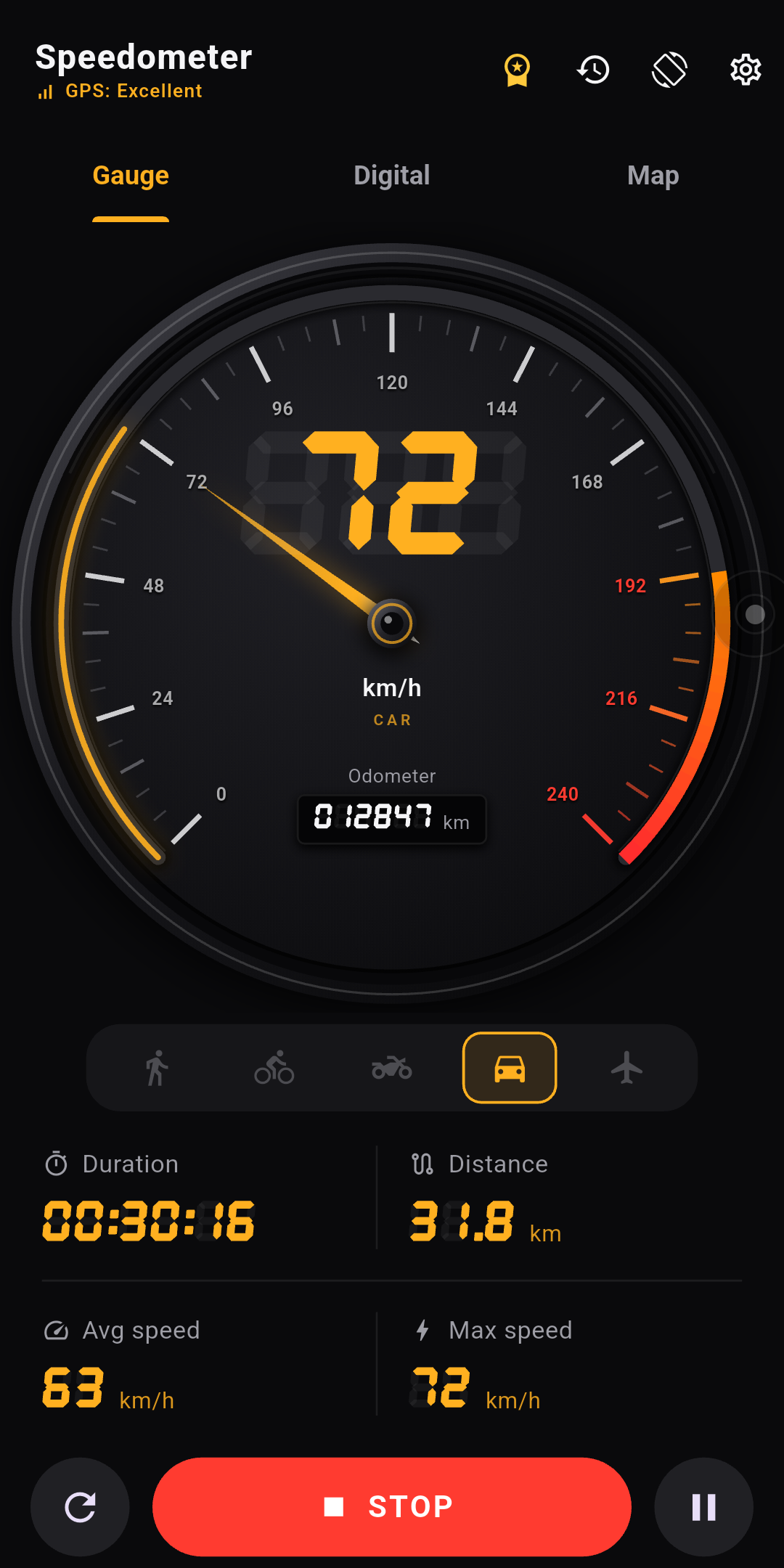
It takes the receiver's Doppler-derived velocity when the chip reports that velocity as trustworthy, and falls back to a guarded distance-over-time calculation only when it doesn't — with a filter tuned so the needle stays dead still at a red light instead of twitching around 3 km/h. A GPS quality indicator sits in the corner reporting the actual fix accuracy, so you always know how much weight the number deserves. Lose the satellites and it says so.
The rest is the dashboard around it: a spring-driven analog gauge, a full-bleed seven-segment readout drawn as real segment shapes so it reads at a glance from a mount, a live route map, and a trip log that records distance, moving time, average and top speed, then draws the route with the addresses you left from and arrived at. Four vehicle modes — walk, bicycle, motorcycle, car — each with its own scale and its own speed-limit alarm. HUD mode mirrors the digits so you can lay the phone flat on the dash and read your speed reflected in the windshield at night.
There is no account and no server. Trips, routes and settings live in a database on your phone. Map tiles and the start/finish address lookups are the only things that touch the network, and the speedometer itself works with no signal at all.
The short version
Your car's speedometer is legally required to never under-read, so it over-reads — typically by 2–7%, and more as the tyres wear. A GPS speedometer measures your velocity independently, via Doppler shift, to well under 1 km/h with a good fix. For the number that matters, trust the GPS — as long as the app is honest enough to tell you when its fix has gone bad.
Ours is: GPS Speedometer: Trip Tracker on Google Play.
A GPS speedometer is a reference instrument, not a legal replacement for your vehicle's own speedometer. Set it up before you drive, never while driving, and obey posted limits.
From the studio
Previous Article
Invalid Scramble Meaning: Why Your Cube Solver Says the Cube Is Unsolvable
Next Article
How to Sign a PDF on Android Without Printing (Free)