21 Day Fitness Challenge for Women: The No-Gym Plan and Daily Checklist
A 21 day fitness challenge for women, no gym needed: five daily habits, a 3-week at-home plan for beginners, and what to do when you miss a day.
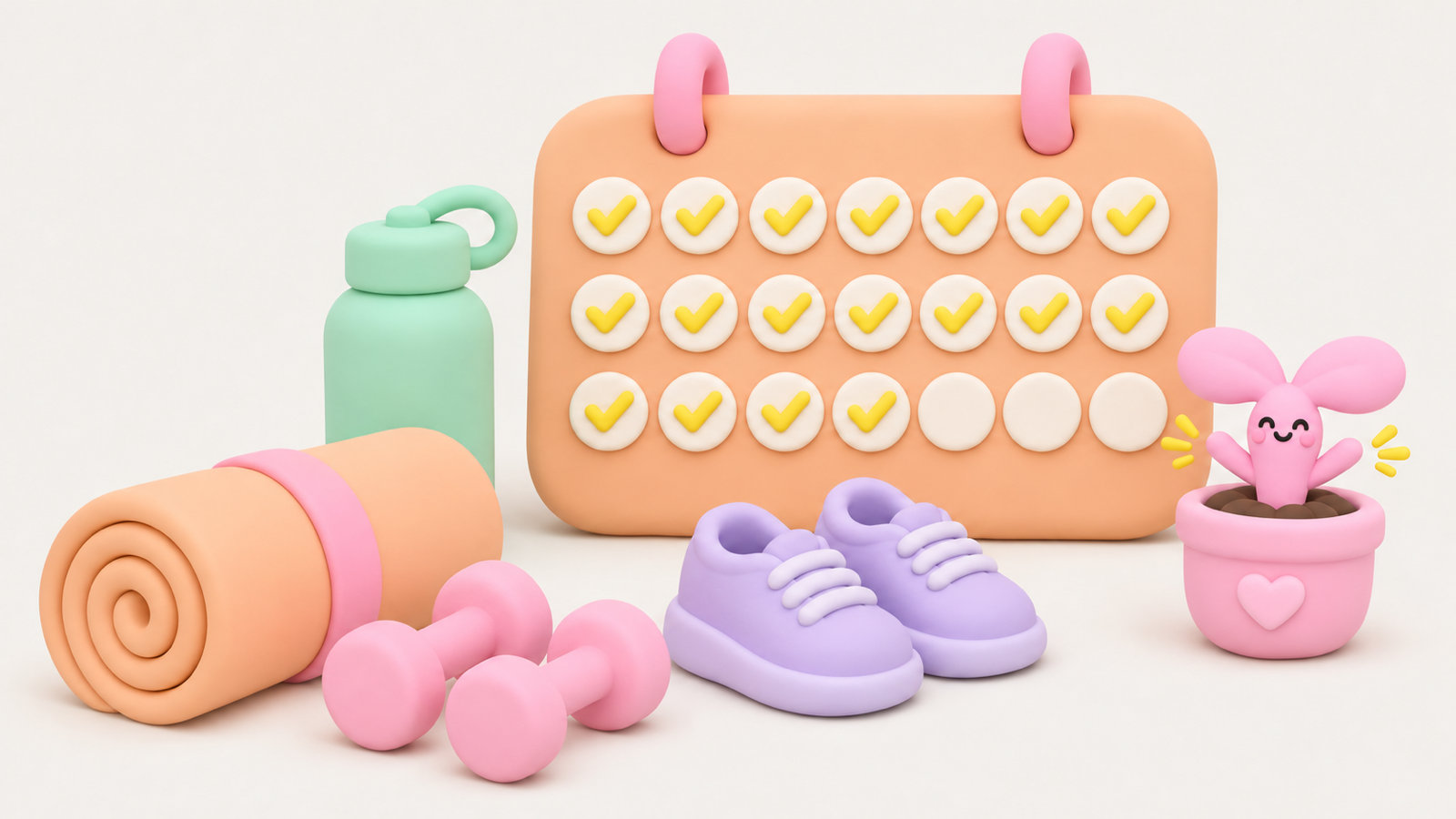
A 21 day fitness challenge is three weeks of the same five small habits, done every single day: move for 30 minutes (or lift), eat protein at every meal, walk 8,000 steps, stretch for 10 minutes and drink your water. No gym, no equipment, no 5am club. Below is the daily checklist, a week-by-week workout you can do in a living room, and the one rule that decides whether you reach day 21.
What is the 21 day fitness challenge?
There is no single official version. Gyms, YouTube trainers and apps all run their own, and they mostly share one shape: a short fixed window, a few non-negotiable daily habits, and a tick for every day you do them. The length is the selling point. Twenty-one days is long enough to carry you through the stretch where most people quit, and short enough to say yes to on a Sunday night.
One honest note on the number. "It takes 21 days to build a habit" is a myth: a University College London study (Lally and colleagues, 2010) found it took a median of 66 days for a new behaviour to feel automatic, and the range between people was huge. So treat 21 days as the start of the habit, the part where it stops feeling new, not the moment it is locked in. If you finish and want more, the 75 soft challenge is the natural next step.
The five daily rules
Every rule is binary: you did it today or you did not. None of them need a gym, and none of them are about your weight.
- Lift or 30 minutes moving. A bodyweight session from the plan below, or 30 minutes of anything that gets you breathing: a brisk walk, a dance class, a bike ride. On tired days the short version still counts.
- Protein at every meal. Eggs, yoghurt, lentils, chickpeas, tofu, chicken, fish. You do not need to count grams; just make sure every plate has one. It keeps you full and helps your muscles recover from rule 1.
- 8,000 steps. The quiet workhorse of the challenge. Phone calls on foot, the long way to the shop, a walk after dinner. On a workout day you are often most of the way there already.
- 10 minutes of mobility. Hips, hamstrings, upper back. A slow stretch before bed is enough, and it is the rule that makes week two's soreness bearable.
- 3 litres of water. A big bottle you refill twice is the easiest way to track it. If you drink far less today, build up over the first week rather than forcing it on day 1.
The 21 day workout plan at home for beginners
Rule 1 needs something to do on the lifting days. This is a simple full-body circuit with no equipment. Do each move for the reps shown, rest a minute, repeat the round.
- Squats to a chair: sit down slowly, stand up fast.
- Glute bridges on your back, squeezing at the top.
- Incline push-ups against a kitchen counter or the stairs.
- Reverse lunges, holding a wall if you need it.
- Dead bugs for your core, slow and controlled.
- Plank on your knees or your toes.
Week 1: learn it
Three circuit days (Monday, Wednesday, Friday), 2 rounds of 8 reps, a 20-second plank. A 30-minute walk on the other days. Do not make anything harder yet; finish every session feeling you could have done more.
Week 2: build it
Four circuit days (Monday, Tuesday, Thursday, Friday), 3 rounds of 10 reps, a 30-second plank. Lower slowly on every rep; that is the cheapest way to make bodyweight harder.
Week 3: own it
Same four days, 3 rounds of 12 reps, a 40-second plank. Add weight with a backpack full of books or two full water bottles. The walk days can become a class if you want one.
That is 25 to 35 minutes on circuit days. If a move hurts (not burns, hurts), skip it and swap in another. If you have a health condition, are pregnant or are coming back from an injury, check with your doctor first; this is a general beginner plan, not medical advice. For a longer, gym-friendly version of the same idea, see the 5-day winter arc workout plan.
The 21 days, honestly
Days 1 to 3 are easy on purpose. Motivation does the work. Use it to make the rules feel almost too easy, because a habit you can do on your worst day is one that survives 21 of them. Take a day 1 photo now; you will want it later.
Days 4 to 10 are the wall. This is where most 21-day challenges die. Your legs are sore from week one, the novelty is gone, and nothing looks different yet. Soreness fades and motivation goes with it. The only job this week is to show up on the flat days, even for the short version.
Days 11 to 21 go quiet. Somewhere in week two the soreness settles and the steps stop needing a plan. By week three the walk after dinner is just what you do. It is not a decision anymore. It is just Tuesday.
What happens if you miss a day?
You do not start over. The all-or-nothing rule, where one missed day sends you back to day 1, is exactly why most people never finish. Missing day 12 after eleven good days still leaves you as someone who trains, not someone who failed.
Two rules work better. First, the short version counts: one round of the circuit or a 10-minute walk on an awful day keeps the chain alive. Second, never miss twice: one gap is life, two in a row is a new habit forming in the wrong direction.
Tracking it, and not doing it alone
A printed checklist on the fridge works for the first week. The harder part is the evening of day 8 when you have not moved and nobody would ever know. Whatever you use needs to hold the five ticks, keep a streak you can see, and ideally involve one other person who notices when you go quiet.
Bloom is our challenge app, and it ships this exact challenge as Strong in 21: 21 days, with the five rules above as daily ritual ticks. A shield absorbs a missed day instead of resetting your streak, a partner (your bestie, your sister, the friend who also hates the gym) sees your checklist every day, and a daily proof photo turns day 1 against day 21 into something you can actually see. You start it with one vow on screen: "I'll go on the days I'm tired, even if it's the short version." Day 1 is free, then you continue with a challenge pass or Bloom+. Get it on Google Play or the App Store.
Common questions
Can you see results from a 21 day fitness challenge?
You will usually feel results before you see them: more energy, better sleep, less stiffness, easier stairs. Visible change in the mirror takes longer for most people. Be wary of any 21-day plan that promises a set number of kilos.
Do I need a gym or equipment for a 21 day fitness challenge?
No. Every move in the plan uses your bodyweight and a living room floor. In week three, a backpack with a few books in it is all the weight you need.
Is 21 days enough to form a habit?
Usually not completely; the UCL research put the median at 66 days. But 21 days gets you through the hardest stretch, and the next three weeks are much easier than the first.
How many steps a day should I walk during the challenge?
This plan uses 8,000. It is high enough to matter and low enough to hit on a busy day without a dedicated walk. If you are far below that now, add 1,000 a week instead of jumping straight there.
What is a good app for a 21 day fitness challenge?
One that holds a daily checklist, keeps a streak that survives a bad day, and lets someone else see whether you showed up. Bloom: 75 Soft Day Challenge was built for that, and its Strong in 21 challenge is this plan, ready on day 1. Day 1 is free; after that it needs a challenge pass or Bloom+.
From the studio
Previous Article
IA para responder mensajes para ligar: cómo usarla sin sonar a robot
Next Article
How to Clear Cache on Mac: Safari, Chrome, Apps and System