
Dopamine Detox Challenge: A 21-Day Plan for Beginners
A dopamine detox challenge for beginners: 5 daily rules, a 21-day plan week by week, what to do when you get bored, and 7 and 30 day versions.
A dopamine detox challenge is a set number of days, usually 21, where you cut the quick hits that eat your attention (endless scrolling, autoplay, phone-in-bed) and replace them with slower things: reading, walking, cooking, talking to people. You are not removing dopamine from your brain; that is impossible and you wouldn’t want to. You are breaking the habit of reaching for your phone every time you feel a flicker of boredom. Below is a beginner-friendly 21-day plan with five daily rules, what each week feels like, and shorter and longer versions.
What is a dopamine detox challenge?
The name is a metaphor. Dopamine is the brain chemical tied to wanting and anticipation, and apps are built to keep you anticipating the next post, the next video, the next notification. A “detox” here means a deliberate break from those cues so that ordinary things (a book, a walk, a conversation) stop feeling boring by comparison.
Extreme versions tell you to sit in a room with no music, food or talking for a day. That isn’t necessary, and a one-day total cutoff tends to end in a rebound binge. A challenge works better: a few clear rules, kept every day, long enough to become normal.
Dopamine detox challenge rules (the 5 daily rules)
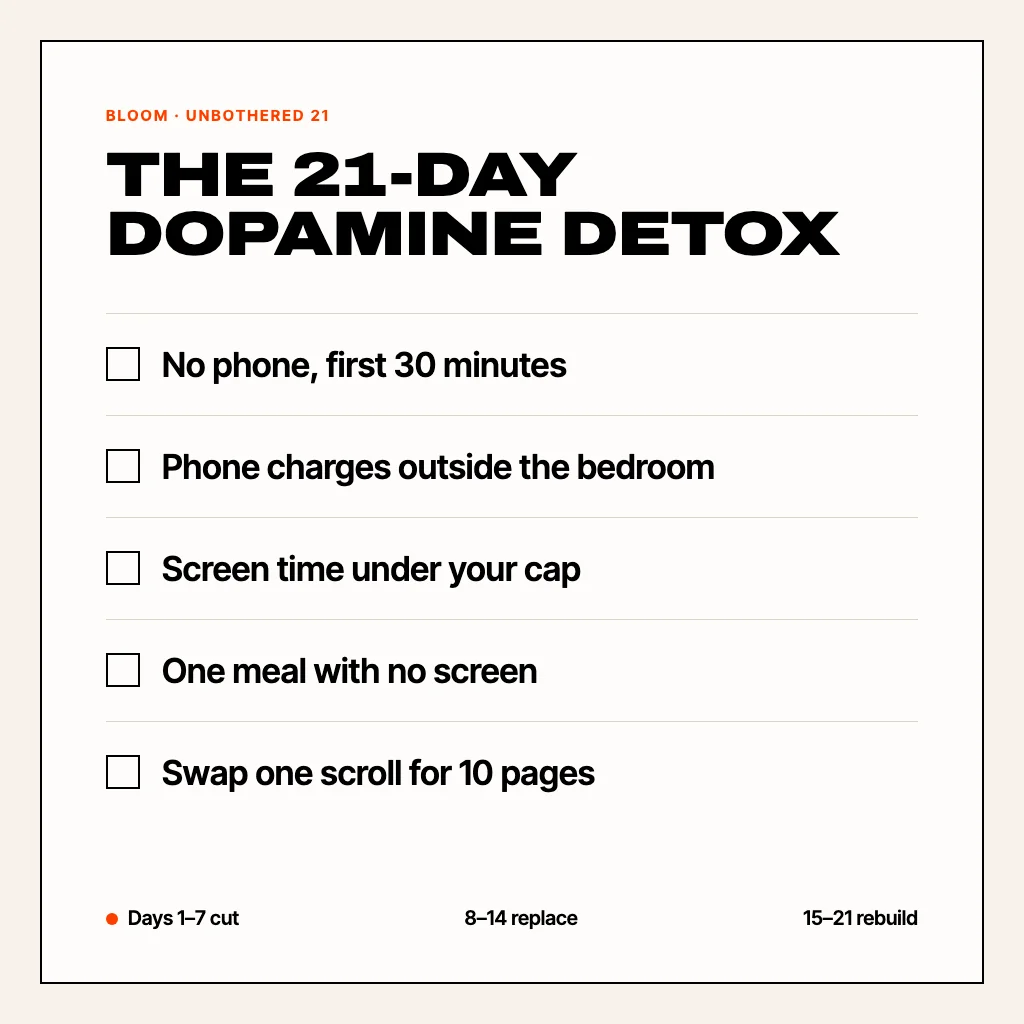
- No phone for the first 30 minutes after you wake up. Get up, drink water, open a window. The morning sets the pace for the day.
- Your phone charges outside the bedroom. Buy a cheap alarm clock if you need one. This single rule fixes most late-night scrolling.
- Stay under a daily screen-time cap. Check your current average in Screen Time (iPhone) or Digital Wellbeing (Android), then set a cap about a third lower. Use the built-in app limits for your worst one or two apps.
- Eat one meal a day with no screen. No phone on the table, no show in the background. Just the food and whoever is with you.
- Swap one scroll for 10 pages. When you catch yourself reaching for the phone out of boredom, read ten pages of a physical book instead.
That’s the whole list. It is deliberately small. You can add rules later; starting with ten is how most people quit on day four.
The 21-day dopamine detox plan, week by week
Days 1–7: cut
Turn off every notification that isn’t from a real person: shopping, news, games, social “likes”. Move social apps off your home screen into a folder on the last page. Log out of the one app you open without thinking. Expect the first three days to feel restless; you will pick up your phone and stare at it with nothing to open. That is the habit showing itself, which is the point.
Days 8–14: replace
This is where most people hit the wall. The novelty is gone and boredom hits hard, usually around days 8 to 12. Boredom here is withdrawal, not a sign the challenge isn’t working. Have replacements ready before you need them: a book on the nightstand, a podcast-free walk route, a recipe you’ve wanted to try, a friend you can call instead of texting.
Days 15–21: rebuild
By week three you will notice you can read a full chapter without reaching for anything. Now decide what stays. Most people keep the phone out of the bedroom and the no-phone mornings for good, and allow social apps back with a firm daily limit. Write down your new rules on day 21 so they don’t quietly slide.
What to do instead of scrolling
- Read on paper (the 10-page rule above).
- Walk for 20 minutes without headphones.
- Cook something from scratch instead of ordering.
- Journal three lines before bed: what happened, what you felt, what you’ll do tomorrow.
- Do a slow hobby: drawing, knitting, a puzzle, an instrument.
- Call someone instead of watching their stories.
7-day, 30-day and 21-day versions
7-day dopamine detox challenge: good as a trial run. Keep rules 1, 2 and 4 only. You will feel the restlessness but probably not reach the payoff.
21-day challenge: the sweet spot for beginners. Long enough to get through the boredom wall, short enough to see the finish.
30-day dopamine detox challenge: use the 21-day plan, then spend days 22–30 tightening your screen-time cap a little more each week. If you want a bigger reset that covers sleep, movement and skin too, the 30-day glow up challenge builds the same habits in, and the 75 day challenge guide covers the longer formats.
Track it so you don’t quit on day 9
The boredom wall is easier to push through when you can see a streak you don’t want to break. A paper sheet works. On your phone (yes, the irony), Bloom has this exact challenge ready as Unbothered 21: 21 days, five rituals (no phone first 30, phone charges outside the room, screen time under cap, one meal with no screen, scroll swapped for pages). You tick them off in a few seconds each evening and close the app, and an AI check-in partner remembers why you started and nudges you on the days you go quiet. Bloom is on Android and iPhone, and Bloom+ starts with a 3-day free trial.
Pair it with a phone-free morning: our that girl morning routine fills the first hour without a screen.
Common questions
What are the rules of a dopamine detox challenge?
There is no single official rule set. A beginner version: no phone for the first 30 minutes of the day, phone charges outside the bedroom, a daily screen-time cap, one screen-free meal, and swapping one scroll session for ten pages of reading.
How long should a dopamine detox last?
Three weeks is a good length for beginners. Seven days is enough to notice the habit, and 30 days is enough to lock in new rules. A single day of cutting everything rarely changes anything.
Does dopamine detox actually work?
You can’t lower your dopamine with a detox, so the brain-chemistry claims are marketing. But cutting cues and building replacement habits does reduce screen time and makes slower activities feel easier, which is what most people actually want from it.
What can I do during a dopamine detox?
Read, walk, cook, journal, exercise, see friends, do a slow hobby. You can still use your phone for calls, maps, work and messages from real people.
Is a dopamine detox the same as a digital detox?
Nearly. A digital detox usually means less screen time. A dopamine detox can also include junk food, shopping or other quick-reward habits, but most people start with the phone because it’s the biggest one.